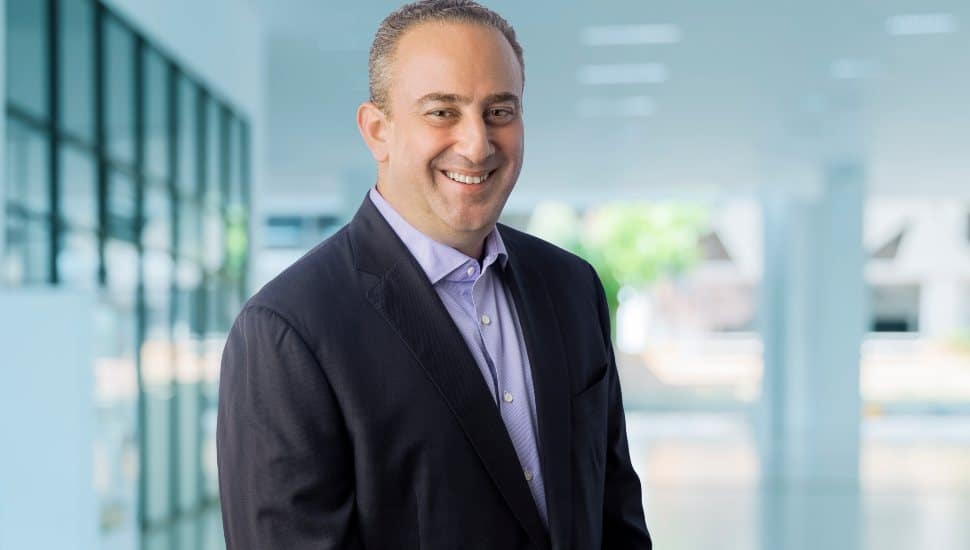
Dan Eisenstadt, Founder and CEO of Terramed Real Estate Solutions, spoke with BUCKSCO Today about his earliest experiments in entrepreneurship as a kid in Westchester County, scalping concert tickets, and selling software in the days of eight-inch floppy disks.
After graduating from UVA Law School and Harvard Business School, having already co-founded the Auschwitz Jewish Center, Eisenstadt went into real estate and founded Terravet, which would later expand to become Terramed.
As CEO, he now partners with Veterinarians and select, passionate Healthcare Providers to upgrade their facilities and diversify their real estate investment portfolios.
Where were you born, and where did you grow up, Dan?
I was born the oldest of two kids in Brooklyn, N.Y., and it’s true what they say: you can take the boy out of Brooklyn, but you can’t take Brooklyn out of the boy. When I was four, we moved to White Plains, in Westchester County, New York.
I am forever grateful to my parents for not moving our family to Long Island!
What did your parents do?
Both of my parents are Psychologists. My mom is a Child Psychologist. My dad did a lot of work with couples.
My folks came from humble means. My mom was a child Holocaust survivor, born in Soviet Asia, in Tajikistan, during World War II. She immigrated in 1949. My dad was born in Brooklyn.
What do you remember about growing up in Westchester?
I went to a parochial Jewish school in the early days. I remember bikes, touch football, and a significant neighborhood culture.
I also remember my early entrepreneurial ventures. I was a paperboy. I shoveled driveways. In seventh grade, I started a business with a friend called D&D Computing, selling software on floppy disks.
Where does that entrepreneurial spirit come from?
Probably my mom. She was working as a School Psychologist, my dad was working at a mental health clinic in the Bronx, and she had that sense of, “How are we going to get these kids through college?”
So, she created a practice, and my father then came into it. They ended up employing seven or eight other Psychologists and bought the building.
I was always that guy. After the floppy disks, it was ticket scalping, back before there was StubHub. That’s the highest margin business I’ve ever been in. Back in ’86 to ’87, I bet you we made $50,000. Before the stock market crash, we had a whole bunch of brokers from Bear Stearns buying tickets.
And then, in college at Clark University, I started selling T-shirts and sweatshirts with my friends.
What music floated your boat in high school?
Billy Joel. One of the greatest concerts I ever saw was in 1986, the night the Mets got into the World Series. It was in Madison Square Garden, and it was delayed until 10:00 PM. Billy Joel came out and said, “Hey, I’m sorry we’re late, but I hear there was, like, a game?” And then he took out a New York Mets hat and played “I’m in a New York Mets State of Mind.”
My other favorite was U2. U2 was my first concert.
What about sports in high school? Did you play any?
I played basketball. It was a Jewish yeshiva team, so at 5 feet 11 inches tall, I was a power forward.
Were you a Knicks fan growing up?
I gave up the Knicks because I hate the Dolan Family as owners, and one of the Sixers’ owners is an investor.
I’m a New York sports fan, but I root for the Eagles as a backup, because I’m a Jets fan, which is hard. And I’m a Yankees fan, so I can root as a backup for the Phillies.
Where did you end up going to college, and where else did you look?
I went to a private Jewish high school in Manhattan called Ramaz, and I got into some schools that they thought I could have gone to, like Brandeis and Washington University.
But I decided on Clark University, which was my safety.
What drew you to Clark, of all the schools you could have gone to?
I needed to be a bigger fish in a smaller pond. Clark’s got a huge international population. It’s 45 minutes from Boston, but it’s a small campus. It’s 2,200 students. And it’s got a reputation for people doing things against the grain. It’s the only university that invited Sigmund Freud to speak.
I was on the student government. I was the graduation speaker. It ended up being a great launching pad for me.
Then you went to the University of Virginia Law School?
I did.
Why UVA?
They gave me money. And it’s one of the 13 schools that consider themselves the top 10.
I expected to be in New York the rest of my life, so I thought I could get a bit of a cross-cultural experience there. And boy, that was true. I met some very smart, politically conservative folks, and it was an incredible experience.
Looking back at your career, who were the people who saw promise in you and opened up doors for you?
For the year after college, I worked for Professor Alan Dershowitz at Harvard Law School, and then I spent a year on a fellowship in Israel, where I met a tremendous entrepreneur, Fred Schwartz, who had a huge impact on my life. His trade name was Fred the Furrier. He had been a poor kid in the Bronx and had built a fur retail empire inside of Bloomingdale’s and Alexander’s, then took it public.
Fred invited me and about 12 Wallenberg fellows at the Hebrew University of Jerusalem to dinner at the King David Hotel. This was in ’92 or ’93. We show up, and he starts pitching this vision to create a Jewish center and museum near Auschwitz, and everyone there, some of whom are still my good friends, started rolling their eyes.
After the dinner, I approached Fred and said, “My mom’s a Holocaust survivor. I’ve been to the former camps. I get it in my gut. But the politics of a post-communist country, Jewish-Catholic relations — this is complicated. Do you have any idea what you’re getting yourself into?”
I vividly remember Fred’s big salesman smile. He said, “Danny, I have no idea, but that’s an advantage. This is going to be hard for you to understand. You come from an academic background. You’ve been taught, appropriately, that knowledge is always good. But it’s probably going to be twice as expensive and take twice as long as I think, and if I knew, I might not do it. What I think is possible is broader than what I might think if I were constricted by knowledge.”
During my first semester of UVA Law School, I worked with him to write a business plan for this, along with a friend who would later become my brother-in-law.
Then, when I was practicing Law at Fulbright & Jaworski in the New York office, doing M&A, Fred said, “We can make this a reality, but I’m 70-something. I think you should leave being a Lawyer for two years. If you put in the sweat equity, I’ll write a million-dollar check. How about you let me know by Friday?”
I told Sharon, my then-fiancée, now wife of 28 years, “I’m trying to figure out what I want to do.” She called B.S. and said, “You know exactly what you want to do.”
Anyone else who saw promise?
After doing the Auschwitz Jewish Center and coming out of Harvard Business School, I came to Philadelphia to work for a wealth management and investment group called CMS Companies. One of the clients was a guy from Columbus, Ohio, named Gordy Zacks.
Gordy had written a book, and one of the senior guys at CMS asked me to pull together some young people. Gordy Zacks says, “Let’s go around the room. Tell me who you are and why you’re here.” The first guy says, “My name is Dave, and I’m here because Dan said so.” Everyone says, “Yeah.”
And Gordy says to me, “I’m adopting you. I’m going to be your mentor.” I had no idea what he was talking about, but he was persistent. He was a very special guy.
Dan, if Gordy were sitting here, what would he say he saw in you?
I think he saw someone who was relationship-oriented, had an ethical frame, some grit, and creativity. I think both Fred and Gordy saw that. We’ve ended up in a very transactional world, and it’s hard to get stuff done that way.
The type of Doctors we’ve chosen to work with, since my partners and I first started Community Veterinary Partners, are incredibly passionate. This is not making widgets. These are animal lovers. Their identity is their practice. You’d have a problem if you said, “I want to buy this and flip it,” as opposed to, “I’m going to partner with you and build a relationship.” That was true when we founded Community Veterinary Partners, and it’s true now with Terramed, even though we’re buying buildings, not the operating businesses.
How would you like Terramed to be known?
Terramed is an Investor, Developer, and Operator of medical and Veterinary buildings across the country. We partner with Veterinarians and Ophthalmologists to acquire buildings and invest in making them as good as they can be to deliver the best care possible.
We sometimes do that by buying a building from a Doctor and leasing it back to that Doctor, or to a company that bought the Doctor’s practice, but we’re improving the facilities in a way we believe delivers good risk-adjusted returns for our investors. In one of our vehicles in our REIT — our private real estate investment trust — about half of our investors are Doctors.
What are you focused on this year and into 2026? What are your priorities?
We originally branded ourselves as Terravet, but we realized a few years ago that the same opportunities that existed with freestanding, triple-net leased Veterinary practice buildings also existed in Ophthalmology, as well as other segments, like fertility and orthopedics.
One of the reasons so many Veterinarians invest with us is that you don’t want to own one building when you’re retiring. You want to own 30. But if you sell your property to buy more, you’re going to pay taxes.
The Internal Revenue Code allows a real estate owner to swap their building for stock in a partnership that owns other buildings, on a tax-deferred basis. You go from owning one building to owning a partnership interest in 20 buildings.
We did that with Veterinarians, and then we started trying to do it with Ophthalmologists, and they would say, “That sounds good, but ‘Terravet’?”
So, you changed the name of the company?
We rebranded to let everyone know that we’re expanding beyond the Veterinary real estate sector, but we’re choosing our sectors carefully. The passion Veterinarians have is great from a tenant profile perspective. Even after selling, they care about the premises.
People ask why we don’t buy Dental practices, and I say, “No disrespect to Dentists, but I know few dentists who went to Dental school because they love teeth.”
Ophthalmologists are surgeons who restore people’s ability to see. There’s a passion there that reminded us of the Veterinarians.
We’re also migrating towards fertility. Fertility Doctors are passionate. They’re creating life.
What are you most excited about right now, Dan?
This is a moment of uncertainty in both the economy and in our world. Those are moments when, on one hand, it can be scary to invest. But it also is when, if you have conviction that what you’re doing makes sense, you can really grow your investments. Terramed has that conviction.
What do you do with all that free time that you have?
My wife and I have become swim buddies. We’ll go to our club and swim laps. I’ve gotten into the cold plunge there.
I’m also a sports fan. I’m a Sixers fan and a big fan of the Tottenham Hotspurs of the Premier League in the United Kingdom, so I’ve got some guys’ trips in the works.
And we still have two girls at home, so being a dad. One of my best roles is being a chauffeur. There’s something about the conversations that happen while driving, when you’re not looking at each other.
Are you a reader, Dan?
I am.
What’s the last book that you read?
A biography of Churchill and FDR.
I’m a big Churchill fan. He was a complicated guy. He was so right when it came to Hitler and Stalin, and so wrong when it came to things like India and women. I love the quote from his graduation speech. “Ladies and gentlemen, members of the graduating class, never give up, never give up, never give up.”
I also read Obama’s biography and Teddy Roosevelt’s biography by Edmund Morris. TR’s “The Man in the Arena” quote is one of the greats.
Another one I thought was really impressive was Team of Rivals, by Doris Kearns Goodwin.
I also like historical fiction. There’s a great one called The Darwin Conspiracy about Charles Darwin’s discovery in the Galápagos and another one called The Weight of Ink about a female Jewish Scribe in 17th-century London.
Three last questions for you, Dan. What’s something big that you’ve changed your mind about over the last 20 years?
Twenty years ago, I knew what I believed and was certain I was right. Now, I am not as certain and definitely want to engage with people whom I respect and with whom I disagree.
I’ve come to the view that part of what makes our country great is that we can hold two competing ideas in our heads at the same time.
There’s a creativity that comes out of a marketplace where different ideas coexist, when we have civility along with it. That’s freedom of religion, freedom of speech, things that are severely under attack in our times.
So, that’s something that has evolved for me. I relish conversations with people with whom I don’t agree.
What keeps you hopeful and optimistic?
My daughters! I’ve got a couple of daughters who are into theater. I’ve got one singing at home, another who does pottery.
As we get older, we become jaded. But when you watch young people, there’s that spark of creativity and positive energy, and that belief that you’ll have the opportunity to do all different things.
Finally, Dan, what’s the best advice you’ve ever received?
One of my favorites came from a Law School professor before the first test.
He said, “This exam may be the first time that you smart people don’t know the answer to a question. I’m going to suggest, rather than freaking out, an alternative approach. First, remember that this is the first at-bat of what is hopefully a long career. So, try to hit the ball. You don’t need to hit it out of the park. Second, remember that the questions to which we do not know the answer are the interesting ones. Use the gift of those questions, and take the opportunity to really think.”
The other came from Fred the Furrier. When we were starting the Auschwitz Jewish Center, I was really mired with trying to figure out exactly what the right next step was.
Fred said to me, “You have to stop treading water and swim. If you keep treading water, we all know what happens. But if you start swimming, even if you need to course-correct, you’ve got momentum.”
___________
Publisher’s Note: Helen Harris contributed to this profile.