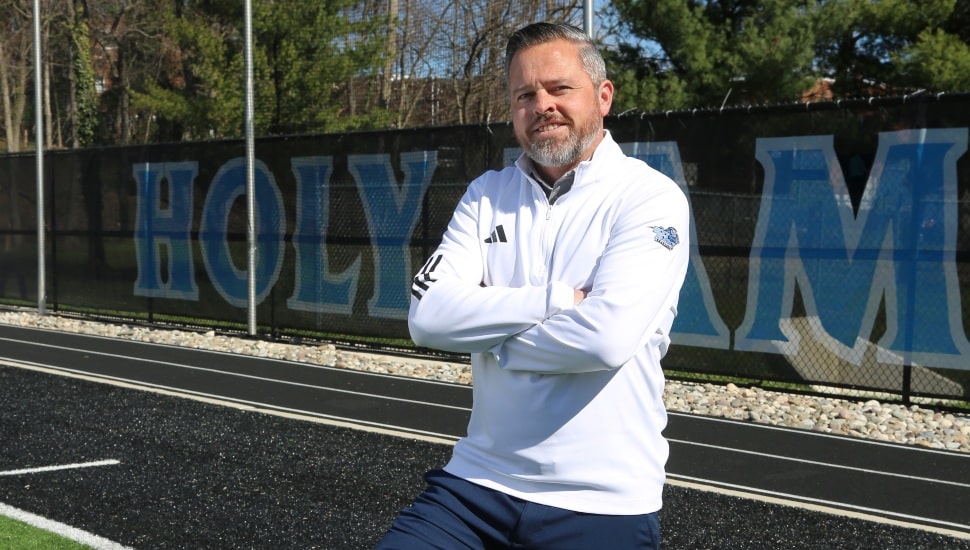
Dr. Troy M. Baker, Head of School at Church Farm School, spoke with BUCKSCO Today about his journey from basketball courts and paper routes on the north side of Toledo to leading the college-preparatory school on a sprawling campus in Exton.
A longtime Educator and School Administrator with a doctorate in Educational Leadership and Policy and a drive to learn and do what needs to be done, Baker did something few in private schools manage: He landed a headship on his first try, something he attributes to Church Farm being the school he is “meant to lead.”
Now, Baker is working to build awareness of Church Farm School as a school unlike any other. He’s prioritizing the student experience, in the classroom and beyond, and finding new ways to ensure Church Farm’s unique commitment to educational access and economic mobility lasts well into the 22nd century. First, though, he’s focused on one thing: “Listening and learning.”
Where were you born, and where did you grow up?
I was born in Toledo, Ohio, just south of Detroit. That’s where I grew up. I moved around the city a lot as a kid, but my home is on the north side of Toledo. It’s an inner-city neighborhood that — I would say — is below working class. You didn’t see a lot of opportunity or mobility growing up in Toledo. There were a lot of gangs, a lot of drugs.
What did your mom and dad do?
My mom was a teacher when I was young. My dad held a handful of jobs.
Where were you in the pecking order?
I’m the second of four. I have an older sister, a younger brother, and a baby sister. My youngest sister lives in Toledo, my brother lives in Georgia, and my older sister lives in South Carolina.
What memories stick with you from growing up in Toledo?
Toledo was a town where high school basketball meant a lot, so my early heroes were guys like Jimmy Jackson and Scoop Williams, LaSean Howard, and legendary Coach Ben Williams.
Playing basketball was my first love. Basketball was an escape for me. It was the first thing in life I poured myself into completely, which — in a lot of ways — probably kept me safe. Memories on the court are the first thing that comes to mind.
Catching fish on the banks of the Maumee River, too. I have some great memories there, connecting with nature in that way. To this day, there’s nothing that quiets my mind and brings me back to center like spending a day fishing.
How good were you at basketball?
Not as good as I thought I was, but I was okay. I was a point guard for Toledo St. John’s, an all-boys Jesuit school. Some of the guys we played against were great. Guys who were going on to Cincinnati to play for Bobby Huggins. I was 6’1” tall and averaged, maybe, 14 and 0.7 assists a game.
Is there a game from your high school days that you remember as if it were yesterday?
There is. The first three years of high school, our Coach, Fred Beier — a legend of a man — would corner me in the hallway and say things like, “I’m not going to shake your hand. You haven’t earned that yet.”
So, we’re in a city semifinal game against Start High School. There are 4,000 people gathered in Savage Hall. We’re down by one, 10 seconds left. I made two free throws. We go up one. I’m thinking we’re going to the city championship. One of my teammates misses a shot, and one of their players sneaks in and makes a layup, and we go down by one.
Our coach calls a timeout. The play is for me to get the ball, drive the length of the court, and make a shot. I do it. The ball bounces in and out. We lose by one.
I didn’t want to go to school the next day. I felt like I let my team, my school, and my neighborhood down.
I got to school, and Coach Beier shook my hand and said, “To be the guy who’s taking that shot for our school is the accomplishment.”
He understood what I needed that day. That moment stayed with me. It’s the foundation of my educational philosophy. My work is to know my students so that I understand what they need on a given day and, hopefully, inspire them.
What about jobs when you were growing up?
My first job was a paper route. It’s an amazing job in terms of learning responsibility, customer service, and how to assert yourself. You’re telling people that they owe you $12, and you’re there to collect.
I also sold portraits. I worked at a car wash. I did what I could to earn a few extra dollars. Sometimes, when I finished my paper route, I would sell newspapers out of a wagon. I worked at a grocery store as a bagger and then as a cashier.
If it sounds like I was always trying to do something here or there to earn some money, it’s because I was. My family, my neighbors, the whole north side, we were struggling financially.
Where did that great work ethic come from when you were a kid?
I’d give that credit to my dad. He taught me how to cut enough grass to buy my own lawnmower, cut more grass, and shovel snow. He was a grinder. He still gets up on election day and drives people to the polls in his own personal vehicle. I learned a lot from watching that.
What kind of music were you listening to in high school and college?
This is back when the East and West Coast had a big rivalry. So, there was Tupac and a lot of West Coast music. Snoop Dogg. Wu-Tang Clan and Nas were big. I loved those guys.
And then there was another genre of music from my parents’ era that would be more of an R&B, old-school sound. So, I had a pretty good mix.
Did you have a favorite artist?
It changed a lot over time. I always liked Michael Jackson. I loved Dr. Dre, N.W.A., Public Enemy saying, “Fight the Power,” that whole voice of proud, young, Black men who looked like me, came from neighborhoods like mine, who were assertive about something. That’s why hip-hop caught my attention, because it offered a perspective I wasn’t finding on TV or elsewhere.
I’m going to guess you were a pretty good student with that work ethic. You could have gone to college anywhere. Where did you end up going?
I started college at Wittenberg University in Springfield, Ohio. It’s in the North Coast Athletic Conference. I went there to play basketball, and I ended up walking on the track team as well.
After a season, though, I decided to go back to Toledo. Wittenberg was expensive. Those were tumultuous times at home, so being closer to home was also a priority.
Ultimately, I graduated with a bachelor’s in Education from Wright State University in Dayton, Ohio.
Was switching back to Wright State the right choice for you in hindsight?
Yes. Wright State was great. I didn’t play sports, but I had a great experience there. I was surrounded by caring professors and friends who worked hard to support and understand me. I learned a lot. And I learned a lot about myself.
Did you go on to graduate school?
I did. I got my master’s from Brown University in Providence, and then I got my doctorate in Educational Leadership and Policy from Vanderbilt.
How did you make that transition from Wright State to Brown University?
It was intimidating. I thought, “Somebody’s going to figure out where I’m from and that I’m not supposed to be over here.”
It finally clicked for me when a professor was unhappy with some writing we had done as a class, and he said, “I’m going to give you an example of what I would consider quality work.” And he puts my paper up on the projector.
I can’t remember a time since then when I’ve felt intimidated. It was the name that I was intimidated by. It wasn’t the actual people. It wasn’t a lack of talent. This imposter stuff, that’s not real. That was an important lesson for me.
Who were the people who saw promise in you and opened up doors for you, Troy?
One is Derrick Williams. Derrick was the Principal at Jonesboro High School in Clayton County, where I worked as a Literacy Coach. He gave me every opportunity to learn, lead, and informally expand my role.
I said to him, “I want to do whatever job you want me to do. You don’t have to pay me more. I don’t care what it is. I want to do it, and I want to learn it.” He took me up on that. I found myself cutting the grass. I was involved in everything to the point where a lot of the kids and teachers thought I was a full-fledged Administrator. He later asked me to be the Athletic Director at Jonesboro High School.
Stuart McCathie is another. Stuart was Head of School during my time at Lausanne Collegiate School in Memphis, Tenn. He hired me to be the Athletic Director there. I was 29 years old. We did so many things together. I started a football program that is ranked — I think — number four in Tennessee right now.
I told Stuart, “Someday I want to be a head of school.” He encouraged me to pursue those skills. He talked to me about not getting pigeonholed in athletics. He made sure I was still teaching English electives and active on the curriculum committee. He gave me opportunities to work in fundraising. I owe so much of my skillset to Stuart’s guidance and leadership.
How did you end up at Church Farm School?
A year ago, I did not think I would be leaving Breck School and coming to Church Farm. Conventional wisdom about becoming a first-time head of school is, “Throw your name out there. Learn. You’re going to get told no. That’s okay. Don’t have an ego.” I said, “Sounds good to me.”
When I got called to Church Farm as a finalist, I was absolutely blown away by the campus and the kids. To arrive at a school dedicated to young men coming from under-resourced schools and communities, kids who need access to an education so they can unlock economic opportunity, you think to yourself, that place must be held together by a wing and a prayer. Instead, I found a sophisticated leadership team with a tireless work ethic, quality faculty members bringing classrooms to life, incredible buildings dotting a campus that looks like a postcard, athletics, arts, and extracurricular programs that rival any prep school. I just didn’t know a school dedicated to boys who don’t come from wealth could be like that.
And, as luck would have it, I got the offer my first time out.
Had you ever heard of Church Farm before?
No. I learned about it through Carney Sandoe, the firm handling the Head of School search. I’ve worked in big K-12, co-ed day schools my entire independent school career. These are the elite private schools most people imagine when they hear “college prep.” Affluent, predominantly white schools with an increasingly diverse student body and driven by tuition and fundraising from wealthy parents and families. These schools are machines. Full of great people. I absolutely loved it. I thrived on the competition of it and the drive to be the best of the best.
Church Farm is a school with a completely different model. It’s an all-boys boarding high school built for those outside the circles of affluence and power. It was not anywhere in the arc of my career, but when I learned about Church Farm, I knew I was the next leader of this school. I’ve brought my competitive side with me. We’re going to be the best at increasing educational access, at teaching adolescent boys, at changing economic trajectories, and at whatever we set our minds to.
You’ve been at Church Farm for 30, 45 days. What’s surprised you the most so far?
I am in awe of Dr. Shreiner’s legacy and what he envisioned more than a century ago. It’s an immense honor and responsibility to step into this role. Like he was, we’re largely reliant on the generosity of friends and neighbors to make his dream a reality. The layers of support from all corners have been a pleasant surprise.
The campus continues to surprise me, too. 150+ acres. Dozens of buildings. The experience we’re able to offer our boys thanks to this campus is astounding.
What are your priorities, Troy? What are you focused on now and through the end of the year?
One of the great things about only being the fifth head of school in 107 years is the stability and tradition that goes along with that. But sometimes you say, “Hey, has there been a new idea? Like, from a leader?”
There are things with the student experience that we could stand to modernize and make more dynamic. You can market all you want. You can have the best flyers and website. But when the kids get here, if they don’t love it, you’re going to be fighting an uphill battle.
Another thing is solidifying the idea of identity. We can improve how we introduce who we are, who we serve, and what it means. Why should you send your son here? We need to be able to tell that story with clarity.
I’ve heard people say about Church Farm School, “Is that a school for bad kids?” And I say, “What are you talking about? These kids are brilliant and personable. They’re building robots and studying in the Galapagos Islands. They’re playing piano and stepping into professional internships. Each one of these guys is going to a top college or university. And they’re graduating with their degree at twice the national average.”
What that conversation tells me is that we need to make more friends. One of my biggest priorities is making sure that we build a similarly strong bond with local businesses, churches, and neighbors.
Another is upholding the power of brotherhood.
I had lunch with an alumnus from the class of 1952. He’s 90 years old. Our highest honor, presented at graduation to one senior, is this pocketwatch known as the Headmaster’s Watch. He won back in 1952, and he’s still carrying that watch around!
That’s the way Church Farm men feel about this place. This is their home because, for so many of them, this was where it all started, the point of origin for the life they didn’t know they could or would have.
Strengthening that sense of brotherhood across the generations is a big goal of mine.
What do you do with all that free time that you have?
I’ve got an 18-foot Alumacraft fishing boat right behind my truck. I fish anywhere I can drop that boat into. That’s still my number one hobby. I’ve gone to Marsh Creek. It’s beautiful. I want to go out to Blue Marsh and the Chesapeake Bay.
Do you read, Troy?
I tend to read books that are centered around education, like The Anxious Generation. I just read a series on leadership in a professional environment.
Lisa Damour is an excellent Writer on adolescent behavior, parenting adolescents, and mentoring and leading them. All of us at Church Farm read her book, The Emotional Lives of Teenagers, this year.
Three last questions for you, Troy. What’s something big that you’ve changed your mind about over the last 20 years?
I have learned that the people who are tough and know what they’re doing are sometimes the easiest on other people.
When I was 29, I was the guy who said, “The meeting starts at 7:30 AM. If you’re not in the room, we will not unlock the door for you.”
Now, I want everybody to know that they’re cared for and respected. I have an expectation of how things are supposed to go, but what I’ve learned over the last 20 years is you can’t lose if you put people first.
What keeps you hopeful and optimistic? It’s a crazy world out there.
Hearing kids tell each other, “You can’t say that.” Seeing kids who are embarrassed by their parents for being culturally insensitive. They appreciate difference and diversity much more than my generation or my parents’ generation.
We give them a hard time for being on their phone and all of that, but in my opinion, they’re the best of us thus far. They care about the environment. They’re civically engaged. They’re registering people to vote.
At that age, I was trying to play basketball and get something to eat. Go to school, get my homework done. These kids are thinking about other things. I think this is the kindest generation we’ve had. That’s what makes me hopeful.
Finally, Troy, what’s the best advice you’ve ever received?
My dad would often say, “A champion is a person who shows up every day.” That’s on a loop in my head sometimes, the importance of showing up for your family, showing up at work, and showing up for yourself.
It’s some of the simplest and best advice I’ve ever received.
____________
Publisher’s note: Helen Harris contributed to this profile.