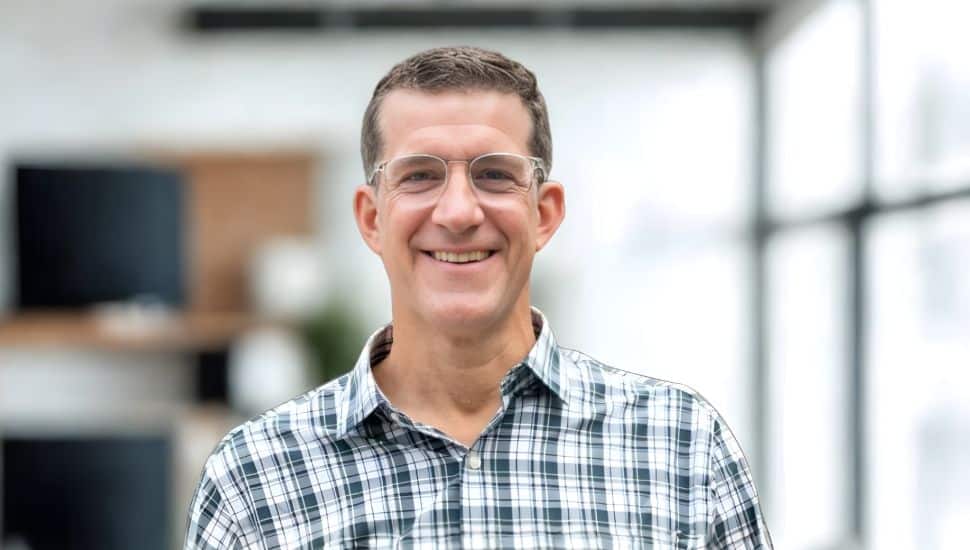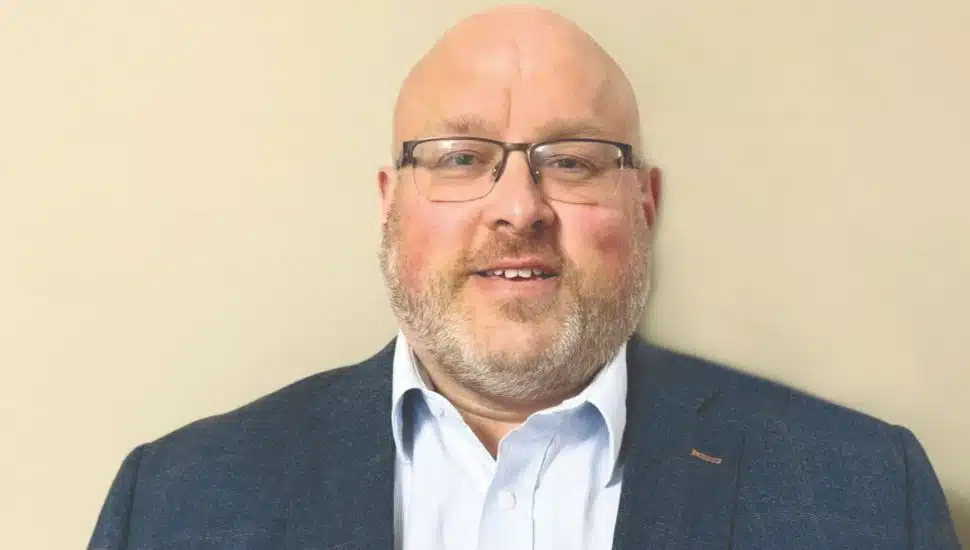

Broc Sandelin, Dean of Agriculture and Environmental Sciences at Delaware Valley University, spoke with BUCKSCO Today about small-town life in Lewis, Kan., working on the farm, and exploring everything from football to 4-H to barbershop quartet with his tiny class of 15 students.
Sandelin grew up on the farm, but was not sure that was exactly where he wanted to pursue a career. His doctorate-level education in genetics and animal science, combined with his practical farm experience, has made him uniquely qualified to guide new generations of students in the much-needed field of agricultural science.
Sandelin is on several boards due to his unique educational background and his success in the field. Last year, he was appointed State Commissioner for the Pennsylvania Commission for Agricultural Education Excellence. He’s also a member of the executive board of the Pennsylvania Cattlemen’s Association and the executive board of the Pennsylvania Beef Council.
Where were you born, and where did you grow up?
I was born the oldest of two kids in WaKeeney, Kan., and moved to Gage, Okla., when I was in second grade due to a job offer my dad received to manage a large ranch down there. We then moved to Lewis, Kan., when I was in the sixth grade, and that is where I consider home.
What did your father farm?
He had various cattle herds throughout his career and helped manage other diverse farming operations over the years, eventually co-owning a cattle Company in Lewis. He is now “semi-retired” but still has a few head of cattle to keep him busy and to keep my niece happy. She definitely got her love of cattle from Papa.
What did your mom do?
My mom was a paraeducator at the local school and helped out in the cafeteria.
What memories stay with you from growing up in Lewis?
Lewis had a population of about 500 people. My graduating class was 15 students, and that was a big class. The school was all in one building.
We had maybe three businesses. There was a co-op for your ag needs, a post office, a small restaurant, and a pub for beer, milk, and eggs. This was in the mid-to-late eighties. Many years after I left, they had a little quick shop off the highway. The high school closed several years ago, and it is now just an elementary school. So, a really small town.
The closest grocery store was about 20 miles away from where we lived in the country, but the Schwan’s man would deliver food to our house every month. We would just put a check and a list on the front door, and they’d put it in the freezer.
Do you have fond memories of it?
I do. You knew everybody. There was no crime. Whenever you needed help with something, call anybody, anytime. My friend group did just about everything together, from sports to 4-H to showing cattle.
Did you play any sports when you were growing up?
Because we were such a small school, we pretty much had to play every sport to make it work. We played basketball, track, and eight-man football.
Our football coach was also our assistant track coach, and he would have us buck hay on the farms for strength conditioning and run on the dirt roads in full pads. “Farm strong” was a little different than “gym strong.”
Which sport were you best at?
When I was a few pounds lighter, I was a sprinter. I did the 100-meter and 200-meter dashes. My top time (in the 100) was 11.7. For a small-town high school, that’s good. And then I played offensive guard on the football team.
Is there one game or moment that stands out as if it were yesterday?
The year we were playing Ingalls High School, they had this superstar running back, Kunkel, who was scoring five or six touchdowns a game. We held him to 54 yards and won the game.
Because it was a small school, we did everything, so 12 of us also had a barbershop quartet called the Dynamic Dozen. When we went to Ingalls to perform, one of our defensive backs, who would improvise rhymes while introducing ourselves, said, “My name is T.J. Barnes. I like to play cards. What was it, Kunkel, 54 yards?” Later in life, they became good friends.
Everybody got a kick out of that.
What about jobs? I imagine you were working on your father’s farm pretty early in life.
My first job was painting feedlot pens when I was eight or nine years old. I did that a lot, and I helped drive tractors back and forth in the field and cattle back and forth on horseback.
When was the youngest you started driving?
Probably 10. We could get our driver’s license (learner’s/farm permit) at 14 in Kansas, but we were 15 miles south of town, so as long as we had a bale of hay in the back and were “feeding cows,” we would drive to school.
What was your first job off the farm?
Between my junior and senior years, my dad and another local farmer wanted to get the kids who worked for them some different perspective on how other people do things, so they switched. I worked for the other farmer, and the other kid worked for my dad and his partner for a summer. I learned a lot from the gentleman I worked for.
What about music? What kind of music floated your boat in high school and college?
I listened to a lot of classic country and also a lot of hip-hop and some rap now and then. I like the beat. It energizes me.
Did you have a favorite artist?
The Oak Ridge Boys were my favorite to start with, and after that, I went to Chris Ledoux, George Strait, and others in that era. However, my wife continues to try to make me a Taylor Swift fan.
So, you finish high school and decide to do something other than work on the farm. What did that decision look like?
I knew that all along I wanted to go to college, but I was unsure about what I wanted to major in. I went to a large school my first year, Kansas State.
Why there?
It was the place to go in Kansas.
When I started, I wanted to be a chiropractor. After a year, I realized I didn’t want to be in an office all day and take all those chemistry classes, so I changed to animal science, and I ended up transferring to a smaller school called Oklahoma Panhandle State University.
Was that a good change for you?
Best one I’ve ever done. It made me who I am today. The faculty there, my fellow students — it was great. It was very similar in size to DelVal.
The town was about 600 people, 1,600 with the college. There was one restaurant and two little quick shops, so it felt like home for me.
How did you decide what you were going to do with your life?
When I transferred to Panhandle State, I knew I wanted to do something in animal science, but I didn’t necessarily want to be a farmer.
My senior year in undergrad, one of my mentors, Dr. Peter Camfield, asked about my plans and said, “You’ve got really good grades. I think I can get you into grad school.”
I got into the University of Arkansas under his former major professor. I got my master’s there in 2001 and my doctorate in 2004 (and still had to take even more chemistry classes).
When did the academic bug bite?
Immediately after graduating, I knew I wanted to teach. I didn’t want to do research. There were only two open teaching jobs in the country for my specialty, which is animal breeding and animal genetics. I applied for both and got the one at Cal Poly Pomona, about 30 miles outside of L.A.
Where does your love of teaching come from?
I would not say I always loved teaching, but I’ve always been in leadership roles and solving problems.
I was a 4-H club president for three years and a high school class president for two, as well as President of the Animal Science Graduate Student Association in Graduate school. I received the Outstanding Graduate Student and Advisor of the Year awards at Arkansas. I taught full-time for five years, and then I had the chance to serve as the department chair of animal science at Cal Poly Pomona. All this to say, I fell in love with administration because I could solve problems and come up with ideas and solutions beyond teaching.
Leaving Cal Poly Pomona eight years later was a tough decision. I’d hired every one of my faculty and staff and had a great team, and left some good friends.
Tell me the story of how you got from California to DelVal in Doylestown.
We wanted to own a home and couldn’t do so due to the high cost of living in California, so I started interviewing for jobs in Kansas, Texas, and Louisiana. None of those panned out.
I happened to be looking at the website again, and there’s Delaware Valley University. I had no clue it even existed. I started researching it, and it was like my undergrad school. It’s got a large agriculture program. It’s small. The farm’s right there. I wanted it. Dr. Benjamin Rusiloski interviewed and hired me, and I started in the summer of 2018.
What challenges and opportunities are you working on at DelVal? How do you deal with the suburbs encroaching on your campus there?
Luckily, most of our farmland is preserved, so there’s no risk of it going into something else. But you still have the encroachment of people, and from a biosecurity standpoint, that’s a big problem. You have the potential of transmissible diseases being carried by dogs, birds, humans, and everything else onto our farm. We try to educate people as best we can, but people love animals. We have installed additional security measures to limit exposure, and if it is safe for people to have close access to our animals, they are welcome to attend our State Fair, called A-Day, which runs the last weekend of April each year.
What are you most excited about in your role as dean?
Getting our Poultry Science Center built. Four years ago, I met with a variety of poultry producers and industry executives and found there was a need for more educated poultry science students. There are only six or seven poultry science degree programs in the whole U.S.
So, we met with Perdue, Mountaire, and Bell & Evans, and Mountaire was the first to commit a substantial amount of money to the project, so we’re naming it after them. We also received funds from Perdue. The Mountaire Family Farms Poultry Science Center will be on the south campus with classrooms, labs, common spaces, office space, and 8,000 birds.
How far along are you?
We’re about 80 percent funded. I meet with the architect every week. Hopefully, we can finish fundraising by the end of this year, and then a year and a half after that, get it built.
What differences are you seeing in the students these days? What big challenges are they facing?
More and more students these days need extra time on tests, testing aids, support animals, those kinds of things to cope with the stress and anxiety of attending college. We have an amazing office that does nothing but learning accommodations, but it’s added a layer of complexity onto everybody’s job, making sure we’re accommodating these students and meeting them where they need to be to be successful here at DelVal.
It’s especially challenging on the farm because some of the students can’t handle loud, sudden noises. And you’ve got to be able to react quickly on a farm when you have a 1,500-pound cow running toward you. We’ve found ways to make it work for some students, but if we think this probably isn’t for you, we’ll tell you. Some students will try it for a year and then switch to another major. Fortunately, we have many interesting majors for these students.
We have a good mix of students in the School of Agriculture and Environmental Sciences who have farm backgrounds and some who have none at all.
Another big challenge we’re having in ag is keeping up with technology. Some of the tractors they’re making now, you can’t even repair them. They have to be fixed by a computer scientist. Current state legislatures, like the “right to repair” laws, are becoming more and more common and are gaining ground at the federal level as well to allow farmers access to the software and parts needed to repair their equipment.
There’s also the ongoing challenge of securing funding, as we are not supported by state resources. Fundraising makes up a significant part of my role — work that I genuinely find rewarding. I value the opportunity to build meaningful relationships, and over the course of my career at Cal Poly Pomona and here, I’ve helped raise several million dollars. I’m really committed to cultivating strong connections with alumni and donors to enhance the educational experience and opportunities available to our students.
But one of the biggest challenges for Production Agriculture graduates right now is acquisition costs for young farmers just starting out. If a student graduates with student debt and no family farm, it’s a major uphill battle to get started and sustain.
There are more and more programs from both state and federal sources coming online to assist these new farmers and ranchers, and with Pennsylvania being the only state that has a specific farm bill, it puts the state in a pretty good position. Based on data from the USDA and PSU-CECD, Pennsylvania is recognized as having one of the highest percentages of young agricultural producers in the nation, with a significant number of farmers under the age of 35.
You’ve got to be creative. A lot of farms are bringing in hayrides and you-picks and other agritainment features, and those have helped a lot.
What are some of the partnerships DelVal has developed over the years?
We have very strong partnerships throughout the ag industry. Mountaire Farms Inc., a major supplier of poultry products, provides internships for DelVal students and hires our graduates as well. In fact, they provided the foundational gift for our new Poultry Science Center.
We have several partnerships with local organizations, but one of the best is our partnership with Bucks County Opportunity Council. We donate 50,000 pounds of produce to them every year, and they come to campus with people to help pick, pack, and sort it to distribute to those facing food insecurity in the county. Our students volunteer to help. We’ve been doing that for 10 years now and have donated over 500,000 pounds for this program.
What do you do with your free time?
My wife and I enjoy woodworking together, and since we had a postage-stamp-sized yard in California, I’ve become just a little obsessed with having a nice green, lush yard. I’m learning more every year, especially thanks to our turf professor, Dr. Doug Linde.
Other than that, I do a lot of reading on leadership. Dave Ramsey, Simon Sinek, John Maxwell, and Seth Godin. And I read a bit of fiction like Tom Clancy.
Do you have a favorite author?
Right now, probably Simon Sinek. He’s got a great book, Start with Why. It’s a leadership framework emphasizing that purpose (the “why”) inspires action and loyalty more than what you do. Inspired by the U.S. Marine Corps’ focus on sacrifice and trust, this approach drives success by fostering a “Circle of Safety” within teams, where leaders put their people first. I try to follow this in all aspects of my leadership.
Finally, Broc, three last questions for you. What’s something big that you’ve changed your mind about over the last 20 years?
Over the last 20 years, I’ve changed my mind about what leadership really is. With an agricultural background, you learn pretty quickly that you cannot control everything. Weather changes, markets move, and sometimes even the best plan needs to be adjusted.
Earlier in my career, I probably thought leadership was about having the answers, just being the boss, and making the tough calls. Over time, I’ve come to see it as much more about staying steady, building trust, adapting when needed, and helping people succeed together. Agriculture teaches humility and resilience, and both have shaped the way I lead.
What keeps you hopeful and optimistic? It’s a crazy world out there.
The students. When they walk across the stage at graduation and give you a big hug. When they call me or message me and tell me about their new job or the veterinary school they got admitted to.
My first graduate student at Cal Poly Pomona is a veterinary behaviorist and a professor at UPenn now. Two of my students, one from Cal Poly Pomona and one from DelVal, both graduated, went to Texas, met in my favorite college bar, and got married last year. That’s how small the ag world is.
Finally, Broc, what’s the best advice you’ve ever received?
I’ve been fortunate to receive great advice from a lot of people over the years, so it’s hard to point to just one. But the common thread has always been that leadership is about people. When you invest in others, treat them right, and create opportunities for them to succeed, the impact extends well beyond your own time in any role.
__________________
Publisher’s Note: Helen Harris contributed to this profile.