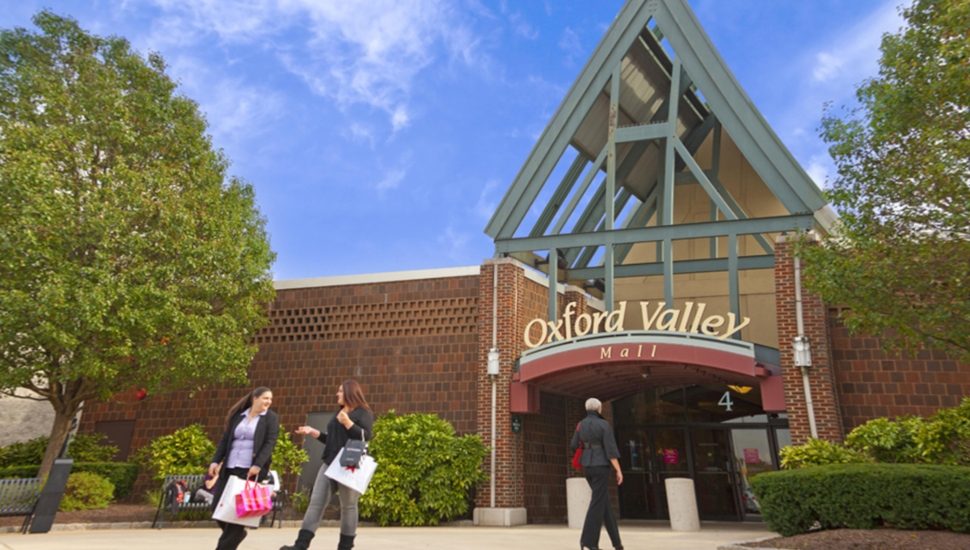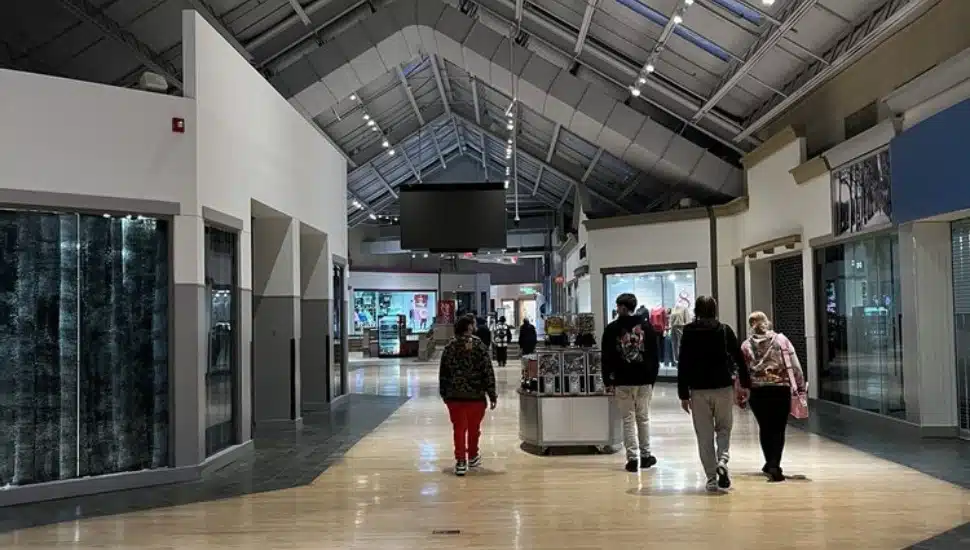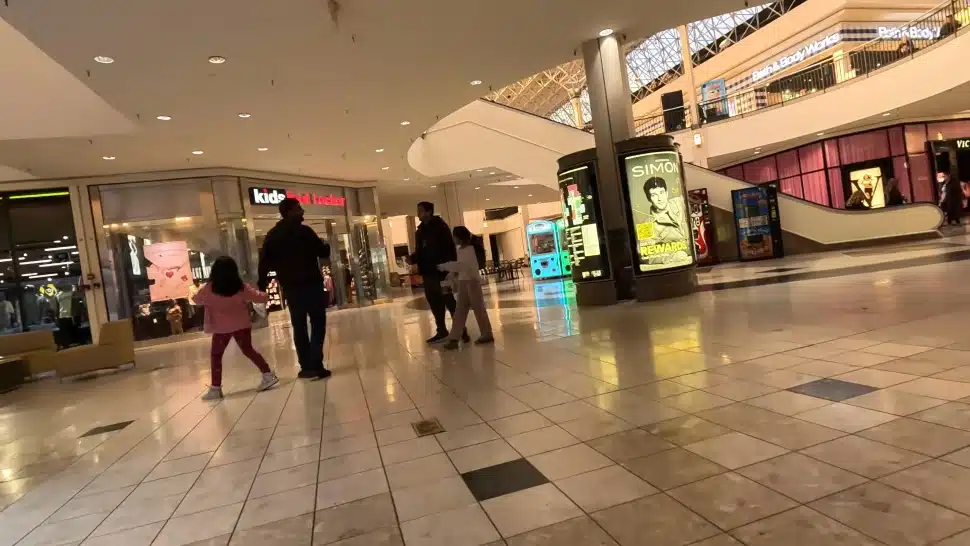
Walk through Oxford Valley Mall on a Tuesday afternoon and something becomes obvious pretty quickly: this place is not what it used to be.
Storefronts sit dark. Foot traffic that once packed the corridors on weekends has thinned to a trickle in spots.
For generations, this was the mall where Lower Bucks County residents shopped, met friends, caught a movie, and spent their Saturday afternoons.
That version of Oxford Valley is largely gone.
What remains is a 1.3-million-square-foot structure with 111 stores, anchored now by just JCPenney and Macy’s, a far cry from the days when Wanamaker’s, Boscov’s, Sears, and Gimbels lined its corridors.
But here is the thing about Oxford Valley Mall: it may not be dying so much as it is reinventing itself.
And what it is becoming could be far more interesting than what it was.
Oxford Valley Mall is not trying to become a better mall. It is trying to become a town center.
When Oxford Valley opened in 1973, it was built to be a destination.
Developed by The Kravco Company and anchored by the kind of department stores that defined mid-century American retail, it drew shoppers from across Bucks County and beyond, a regional hub at the crossroads of Route 1 and I-295.
For decades, that formula worked. Then it did not.
E-commerce hollowed out the department store model. Anchor after anchor went dark.
The 2008 recession accelerated the slide, and the pandemic finished off whatever momentum was left in traditional enclosed retail.
Oxford Valley was not alone.
Across America, mall owners faced the same reckoning. The ones who survived did so by becoming something different.
The model that has gained traction is the mixed-use town center: housing, dining, healthcare, entertainment, and retail woven together into a single destination that people visit multiple times a week, not just when they need to buy something.
That is exactly what Oxford Valley is attempting. And the most visible sign of it is already open.
Simon Property Group, which owns 85.5 percent of Oxford Valley Mall, sold 20 of the property’s roughly 135 acres to Villanova-based developer CornerstoneTracy.
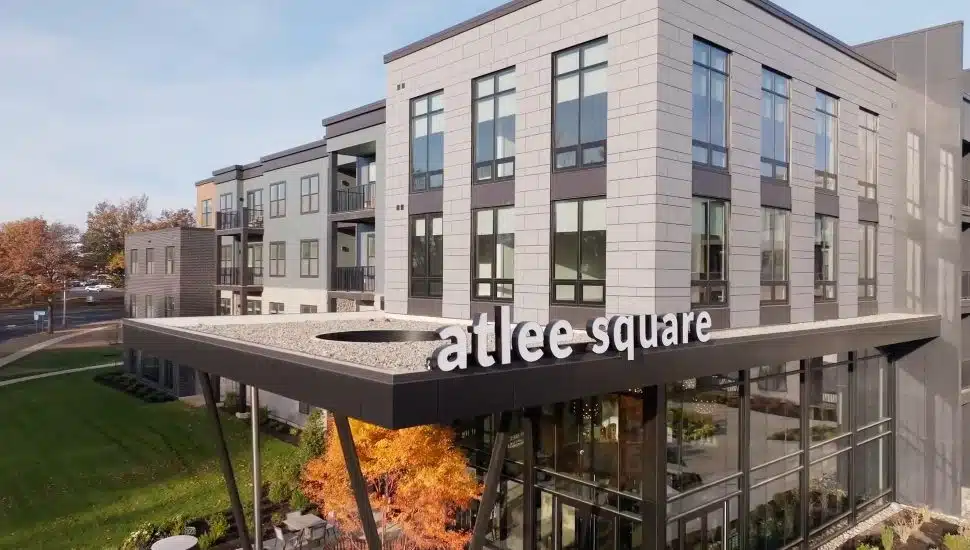
On the footprint of the demolished Boscov’s and its surrounding parking lot, a 600-unit luxury apartment complex is now rising.
Atlee Square opened its first 391 units in August 2024, targeting young professionals and older adults. Rents run from roughly $1,965 for a studio to $3,810 for a three-bedroom.
Phase II, another 223 units, was slated to break ground this year. If both phases are completed, it will be the largest residential development ever built on mall property in Bucks County.
The residential piece is moving. The mall itself is a different story.
Atlee Square developer David Della Porta, whose firm has been working with Simon since 2019, has not hidden his frustration.
“We haven’t had a lot of new news out of Simon, so we haven’t seen, frankly, what we had hoped to see up until now in terms of redevelopment, new tenants,” he told the Bucks County Courier Times late last year.
Della Porta says he continues to hear that Simon is working actively on the broader redevelopment. “The whole point of our community was to kick-start the bigger redevelopment of the entire mall property,” he said.
So far, the apartments are doing their part. The mall is still catching up.
Healthcare may be the next piece. Capital Health owns a medical building on Middletown Boulevard in Langhorne, directly adjacent to the mall property.
The health system has been weighing whether to convert it into a micro-hospital, a multi-specialty ambulatory hub, or some combination.
As of early 2026, Capital Health confirmed it is back in the development stage for the site, a project that has been in motion, in various forms, since 2019.
If all of this sounds ambitious, consider that it has already happened nearby, and more than once.
In Delaware County, the Granite Run Mall closed in 2015 after four decades.
What replaced it, the Promenade at Granite Run, is now a functioning mixed-use town center with 400 luxury apartments, retail, restaurants, and medical offices.
It took the better part of a decade. It works.
In Montgomery County, Plymouth Meeting Mall is currently under contract for a similar transformation, with plans calling for Plymouth Meeting Town Center, a redevelopment that would include housing, a youth center, playing fields, restaurants, and hotels, with most of the existing mall demolished in the process.
Oxford Valley shares one key advantage with Plymouth Meeting that Granite Run never had: it never closed.
The 190-acre property still draws traffic, still has working anchors, and sits at one of the most accessible intersections in the entire Delaware Valley, minutes from Route 1, I-95, I-295, the Pennsylvania Turnpike, and a SEPTA rail station.
When Della Porta’s team was pitching the project, Simon’s own data showed the average household income within a few miles of the mall at nearly $97,000, with customers stretching from Northeast Philadelphia to Central Bucks County and across the river into New Jersey.
What is missing is a landlord willing to move. Six hundred apartments are going in. A hospital-scale healthcare facility is being reconsidered next door.
Neighboring malls in Delaware and Montgomery County are already tearing down and rebuilding.
The bones of a town center are taking shape whether Simon moves quickly or not.
Lower Bucks County has been waiting a long time for a real downtown. Oxford Valley Mall, of all places, may be where it finally gets one.
The question is no longer whether Oxford Valley Mall survives.
The more interesting question is what it is becoming.
_____