If you’ve ever flown into Philadelphia from the New Jersey side, you’ve passed right over one of the most dramatic and least-known battles of the American Revolution.
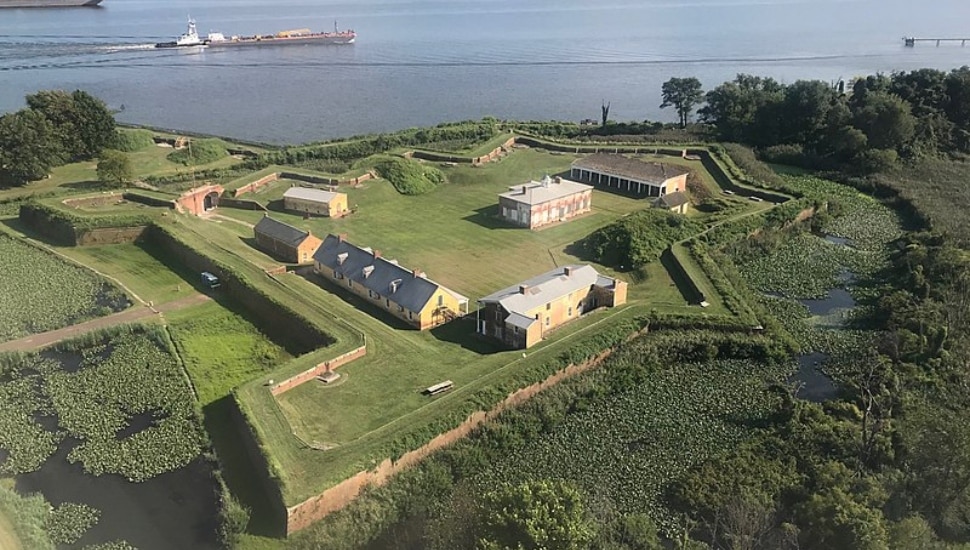
Fort Mifflin, now sitting directly beneath the landing pattern of jets heading into Philadelphia International Airport, looks quiet today.
But in the fall of 1777, this muddy island in the Delaware River was the scene of one of the most lopsided, desperate, and important fights of the entire Revolutionary War.
Philadelphia had already fallen. The British Army occupied the city. Washington’s army was battered from the Battles at both Brandywine and Germantown. Morale was slipping, desertions were rising, and winter was closing in.
The only thing standing between British control of Philadelphia and an open supply line up the Delaware was two small American forts: Fort Mercer on the Jersey side, and Fort Mifflin on a soggy patch of land barely above sea level.
The stakes were enormous. Whoever controlled the Delaware River controlled Philadelphia’s lifeline.
The Americans had sunk giant underwater defenses, called chevaux-de-frise, to block British ships. Fort Mifflin and Fort Mercer sat on opposite shores, forming a deadly crossfire protecting those obstacles.
Washington understood this was the hinge point of the entire campaign. If the British opened the river, Philadelphia would be fully supplied, his already-shaken army would face new pressure, and the Continental Congress, already forced to flee to York, would lose its last hope of retaking the capital.
And yet the battle that followed was almost comically uneven.
The British unleashed more than 200 cannons from ships, floating batteries, and land batteries along the shore.
On Nov. 15 alone, they fired over 10,000 shells, the heaviest bombardment ever seen in North America at the time.
Massive 18- and 24-pound balls ripped through the fort’s walls, shattered gun platforms, set buildings on fire, and sent fountains of mud and splintered wood into the air.
The Americans? They had maybe a dozen usable guns. Ammo was low. Powder was short. The walls were collapsing. Men had to fire cannons while standing in mud and river water.
Tents were shredded. Barracks were smashed. Each night, the defenders rebuilt what the day had destroyed: gun platforms hammered back together, walls patched with mud and broken lumber, shattered embrasures repaired by lantern light.
Washington kept reinforcing the fort even though he desperately needed those men for his own army. He understood the fort didn’t have to beat the British, it just had to last.
Every day Fort Mifflin held out was another day the British couldn’t resupply their army in Philadelphia.
Every day bought Washington time to stabilize his lines, reposition his troops, and prepare for the inevitable winter encampment at Valley Forge.
What ultimately broke the fort wasn’t British strategy but physics. The walls finally crumbled. The guns overheated. The fort itself stopped being a fort.
On the night of Nov. 16, Major Simeon Thayer organized a daring evacuation. The defenders slipped away by boat, leaving the American flag flying above the smoking ruins.
When the British entered, they found a fort that no longer existed in any meaningful sense, just a wrecked shell that had cost them five precious weeks.
Thomas Paine visited during the siege and captured the moment better than anyone. He wrote that the defenders had “scarce anything to cover them but their bravery” and finally “gave up more to the powers of time & gunpowder than to military superiority.”
In Paine’s telling, Washington’s army wasn’t defeated, it simply ran out of fort.
Today, when those jets roar overhead on final approach, most passengers never realize they’re crossing the spot where a handful of mud-covered patriots stalled an empire long enough to save Washington’s army.
Fort Mifflin didn’t just fight a battle. It bought the time that helped win a revolution.
__________
Publisher’s Note: Much of the inspiration and historical detail in this piece comes from Jim Murphy’s Real Philly History, Real Fast, published by Temple University Press in 2021.
__________
Join Patrick Jordan at Fort Mifflin for the 240th anniversary of the 1777 siege, where a half-finished fort on a muddy island withstood the mightiest navy of the 18th century, endured the heaviest bombardment of the Revolution, and bought Washington the time he needed to reach Valley Forge.