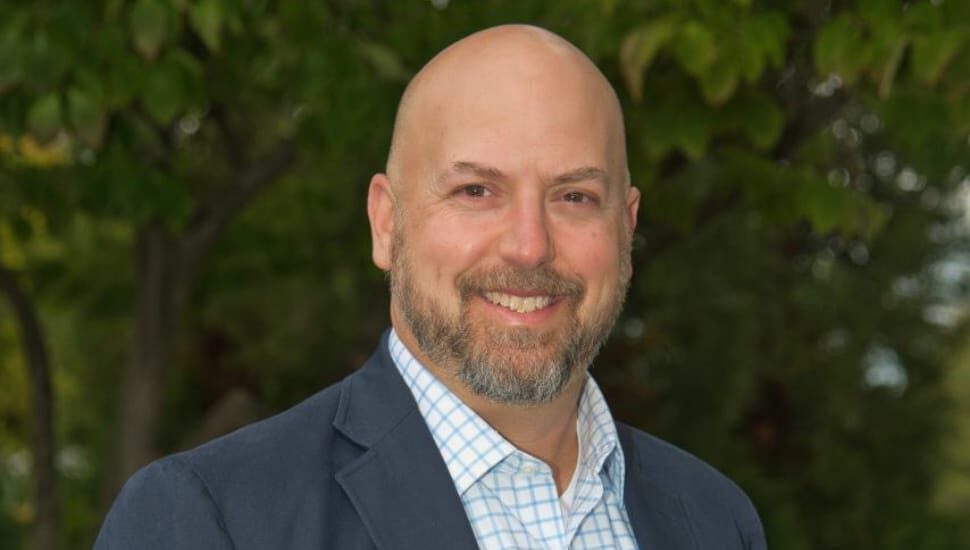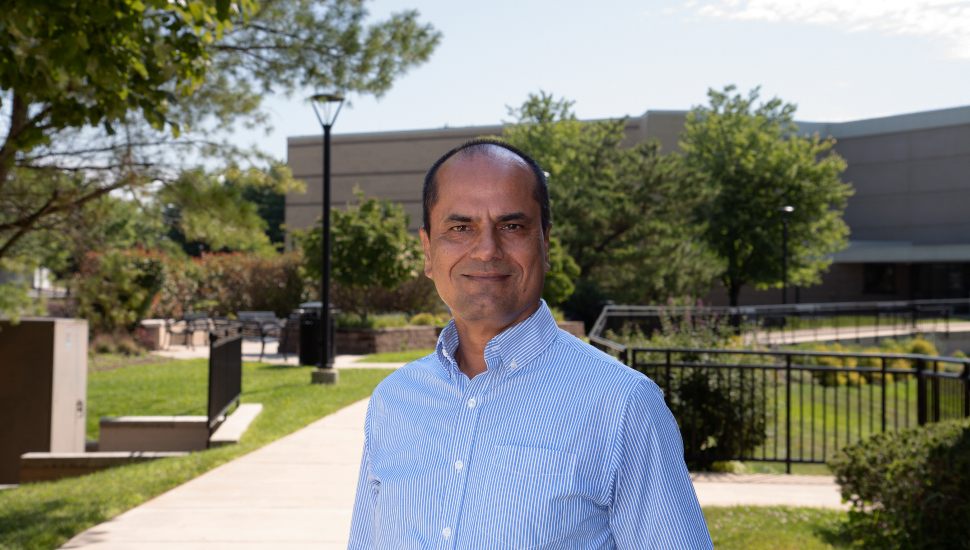

Raghu Sangwan, Associate Chief Academic Officer and Director of Engineering Programs at Penn State Great Valley, spoke with BUCKSCO Today about his childhood in India as the eighth of nine siblings in a military family.
Frequent moves made him introspective and academically driven, eventually leading him to pursue computer science in the U.S. after an unexpected medical disqualification from the military.
Sangwan discussed how influential mentors shaped his path from researcher to educator, why he left academia for industry (and returned), and how he’s now reshaping graduate programs with a product development mindset. He also shared how his views on AI, parenting, and education have evolved.
Where were you born, and where did you grow up?
I was born the eighth of nine siblings in the city of Ambala in Northern India. At the time I was born, it was part of the state known as Punjab.
What did your parents do?
My dad was in the Indian armed forces, and my mom took care of us — that was a full-time job in itself.
What do you remember about growing up? What memories stay with you of that time?
Being in the military, we were always stationed in some interesting parts of the country.
Being on the base with other families was like the village raising the children. We were all together. Our parents didn’t have to worry because it was the base. We had the freedom to ride our bikes wherever we wanted to, like wooded areas on the base.
We moved around often. Every three years or so, my dad had to move to a different base.
How did you adjust to your family’s frequent moves?
It made me a little introverted because making new friends quickly was not so easy. I was a little more serious growing up and would often sit in class, focusing on my studies. I made a few friends, but they were really good friends.
Did you have part-time jobs when you were a teenager?
I didn’t work any part-time jobs, but sometimes my dad would be at a location where families couldn’t go. On such occasions, it was just my mom taking care of us. That meant we had to help her out. I would take public transportation by myself to get to school starting around fifth grade, help her with household chores, and run errands.
Did you play any sports?
I played cricket during my high school years, as well as volleyball. I was fortunate enough to make the high school team, but I wouldn’t say I was one of the best.
Do you have a favorite memory that stands out from playing cricket or volleyball?
Volleyball allowed me to travel to play against other high schools in other parts of the country. The travel itself and hanging out with your buddies for those trips — those are the memories that come back when I’m reminiscing.
Where did you end up going to college, and why there, Raghu?
I intended to join the armed forces, just like my dad and my older brothers. When you finish high school in India, you move into what is called the National Defense Academy, where you finish your college and you train for the military.
There is a national exam and an interview for it. I got through all of that. But in the final stages, they do a fitness exam, and it turned out I had a condition that could be an issue under stress.
It was disappointing, but my dad figured I was good at academics, so I could pursue engineering. But because I had only trained or prepared myself for taking exams for the National Defense Academy, I never prepared for other entrance exams.
So, I enrolled in the bachelor’s program in Mathematics at the University of Delhi and planned to take the entrance exam for engineering a year later.
My dad, as we were touring the campus, ran into a professor who was a good friend of his. He said, “Mathematics is a good field, and so is engineering. But he should do something different where he has more opportunities.”
He recommended an agricultural university where most of the professors had been educated in the United States, and many students from there eventually went on to study in the U.S. That’s where I ended up. My bachelor’s degree was in Genetics and Plant Breeding, and I went on to pursue my master’s in the same field.
Computers came into play at that time. Many of my friends who were studying at the postgraduate level were collecting data from the field and taking it to the data center, where somebody who knew how to program would write the code using punch cards to analyze their data. I got familiar with that process, and I was intrigued by it.
My brother-in-law was a professor of Political Science, International Relations, and Public Administration at West Chester University. He told me about the emerging field of Computer Science. I was intrigued, so I applied and was accepted.
I finished my master’s at West Chester University. My professors, including my brother-in-law, thought I was a good candidate for a Ph.D. I had a job with Bell Atlantic, and I was not interested in pursuing further education, but my dad twisted my arm and said, “Teaching is a noble profession.” So, I listened to him, and the rest is history. I went on to Temple University for my Ph.D.
What surprised you the most when you first got here about life in America?
I arrived here when I was 24. I was so mesmerized by the beauty of the place and the lush greenery. West Chester is a beautiful town and university, with old, historic buildings.
The professors’ approach to teaching was quite different. In India, we’re accustomed to a hierarchical system. In India, you prepare yourself really well before asking a question, because if you don’t, you’ll be given a hard time. Here, you could go in at any time, ask anything, and they would sit down very patiently to teach you. I loved that open relationship between the professor and the student, where you could walk in uninhibited and explore things. I wasn’t accustomed to joking around with my professors — that was quite refreshing. I became a little less introverted.
Looking back over your career, Raghu, who were the people that had an impact on you, saw promise in you and opened up doors for you?
There were a couple of professors I had at West Chester University who saw promise in me and encouraged me to pursue higher education beyond the master’s.
One was Professor Edelman. He was my favorite. He was so passionate. None of his classes were boring. He would teach in a way that I didn’t have to go back and relearn that stuff. I would absorb it in class, and it became a part of me.
My Ph.D. Adviser, Dr. James Korsh at Temple, said, “You’ll be a great teacher. Go to a teaching school for a year or so before you graduate and see what it’s like.”
So I went to Shippensburg University for a year. Because Computer Science was still not where it is today — it was taught out of the department of mathematics at most schools — I was the first computer science Ph.D. there. They asked me to develop a graduate program, and while I was helping them develop the graduate program, they asked me to teach their graduate courses. There were many graduate students who were in the military who would ask questions based on their field experience, and my answers were often textbook-based. In my heart, I was not enjoying that.
I thought, “I need to go out and do it for myself before I can teach.” So, I decided to work in the industry to see how it’s done before returning to the classroom.
Where did you go?
I worked for Siemens for about five years. As a Ph.D., I was liaising between the Siemens Healthineers in Malvern and Siemens Corporate Research in Princeton. Siemens Corporate Research’s goal was to collaborate with various business units within Siemens and support projects in their early stages, helping them get on the right track before undertaking full-scale development.
What do you think they saw in you? What did you bring to the table that was different than most people?
I’m able to communicate technical concepts clearly. On technical projects, there’s the business side that has a problem to be solved, and then there’s the R&D side. There needs to be somebody in between that can take the business problem, apply the technology, and then take it back to the stakeholders.
That back and forth is a unique space where you need to have an analytical mind, good communication skills, and be able to be in front of the customer.
So, what are your priorities at Penn State Great Valley?
Being a school of graduate professional studies, we are always forward-looking because we want to stay current and provide the best education to our customers, who are working professionals. Having come from product development at Siemens, I believe in creating products that delight customers, and that’s the philosophy I’ve adopted here.
I took a very different approach to developing programs. There is a concept in the business world known as a value proposition canvas, which examines a need from two perspectives. It puts customers on one side and the product development team on the other side. You’re trying to find a product/market fit and determine what the need is.
I’ve been going through that exercise with all our programs and restructuring them. I noticed, for example, that it takes a long time to complete your program, and you have to wait until the end of the program to receive your degree, which allows you to demonstrate to the world that you have the necessary credentials. Why not split the program into stackable certificates? You can award these credentials, including certificates, much sooner than a degree.
And when we did that, we went through an exercise to figure out what the industry roles were. What jobs do they do? What kind of skills are needed in those jobs? Are these certificates imparting those skills? We did that for all six of our engineering programs over the past two years.
So, what’s your next step? What are you excited about?
The next frontier is, of course, AI. The world feels like AI is going to take over, and some jobs are going to disappear. I think differently. For years in the United States, people have been working harder and longer, and what AI is going to do is give us the balance that we need.
AI is going to take away the grunt work that goes into producing something. Imagine somebody doing research. Back in the day, you had to go through the index cards, find the journals, go through the journals, find the papers, thematically organize the papers, then look at whether those papers are relevant and whittle them down to the things you need to read. That took a long time.
Now, AI can do that for you in a matter of minutes. So, ask yourself, all that I did — was that a skill that made me better at doing what I do? Was that time well spent? What did I gain from doing that? It’s a repetitive task that doesn’t really make you an excellent writer. What makes you an excellent writer is that once you have your sources, you go through them and pull them together. AI is going to help with that. And that’s the case with many jobs out there.
We need to start thinking about how we teach our students to effectively utilize these tools. How do we force them to think more at a meta level? Becoming better problem solvers, better critical thinkers.
To me, how you apply knowledge and how you solve problems is more important. So, we are going to take our assignments and assessments and turn them into more problem-solving, critical-thinking, and analysis-type assignments. Rather than trying to keep AI out, we’re going to pull AI in and ask our students to use these AI tools and then ask them how they went about solving the problem. We want to see their thought process and reasoning.
I think it will make people enormously productive. It’s going to give them that busy time back so they don’t feel overworked. And, frankly speaking, the output that comes from somebody who’s overworked is not as good as if they feel much more relaxed and engaged.
So, what do you do with all that free time that you have?
When I have free time, my first thing is to decompress. I walk on the Chester Valley Trail — I try to get a couple of miles a day. And I’ve fallen in love with audiobooks — after reading all day, it’s a relief.
What’s the last book you read?
I’ve been fascinated by Buddha. He wrote a book called Dhammapada. I want to know what he was thinking and how he achieved what he did.
Three last questions for you. What’s something big that you’ve changed your mind about, Raghu?
Parenting. I grew up in an environment where my parents placed a great emphasis on academics and steered us toward opportunities. I assumed I’d guide my son the same way. He’s good at Math, so I thought Engineering was a natural fit.
He toured Penn State, loved the campus, and the engineering labs. In high school, he’d taken up the hobby of flying planes. He said he’d pursue Aerospace Engineering. After a semester, he said, “Dad, I wanted to show you I could do it, but that’s not where my heart is. I love flying, and I’m not the type of student this discipline needs.”
My wife, Shailey, said we should trust his instincts. He changed his major to Business, thinking he might do Aviation Management. Now, he’s at United Aviate Academy, training to become a commercial pilot. He’s happier, and I’ve learned to let him steer.
What keeps you hopeful and optimistic? It’s a crazy world out there.
Just as there are forces that disrupt things, there are also forces that bring peace and harmony. And if those who want to bring peace and harmony keep their focus in the right place, eventually things will be all right.
Finally, Raghu, what’s the best advice you’ve ever received?
I was at Siemens, and the company was undergoing an assessment called the Capability Maturity Model. Engineering organizations were measured against that Capability Maturity Model. The companies that were at the highest level could work on large, complex projects and produce repeatable and predictable outcomes.
My program manager said, “Pretend you are at the highest level and ask yourself what needs to be done to be at that highest level, and just do it. The rest will take care of itself.”
Whenever I have a problem, I think, “If I were the best at solving that problem, what would I have to achieve?” And I set that as my target and got to work.