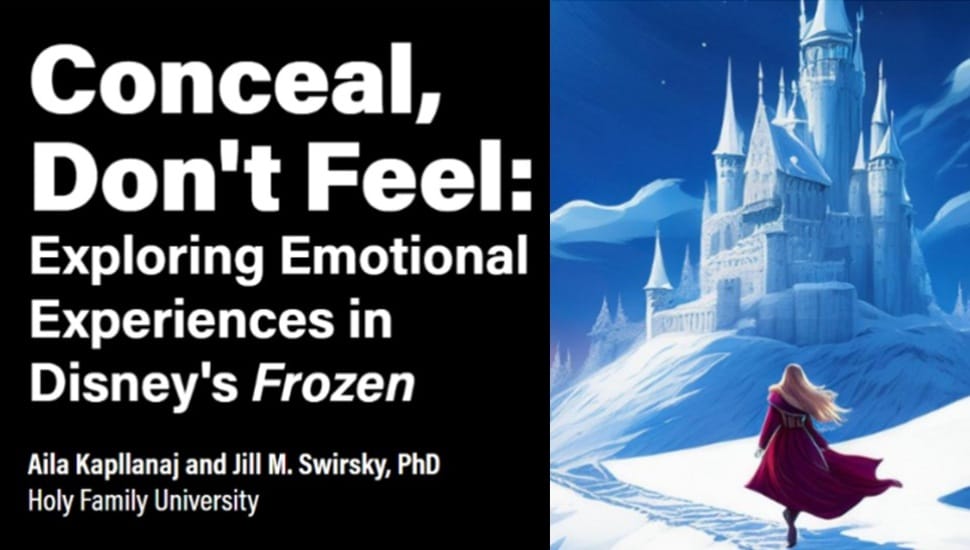

What makes the Disney classic Frozen so emotionally powerful?
Holy Family University’s Dr. Jill M. Swirsky, assistant professor of psychology, and Aila Kapllanaj, a first-year biochemistry student, set out to answer that question in their newly published article, “Conceal, Don’t Feel: Exploring Emotional Experiences in Disney’s Frozen.” Featured in the spring 2025 issue of Eye on Psi Chi, the official publication of the International Honor Society in Psychology, their research unpacks the film’s rich emotional landscape through the lens of psychology.
Drawing on Paul Ekman’s six primary emotions — happiness, sadness, fear, disgust, anger, and surprise — Swirsky and Kapllanaj analyze how Elsa’s journey mirrors real-world emotional experiences. They explore how fear of her powers drives Elsa into isolation, how stress triggers a fight-or-flight response, and how self-acceptance ultimately leads to happiness.
By applying established psychological theories, they reveal Frozen as more than just a beloved animated film — it’s a lesson in emotional resilience and mental well-being.
This unique professor-student collaboration highlights the power of interdisciplinary learning, blending psychology and storytelling to make complex concepts engaging and accessible. Their work showcases how popular media can serve as a valuable tool for understanding emotions and mental health.
Read the full article in Eye on Psi Chi.