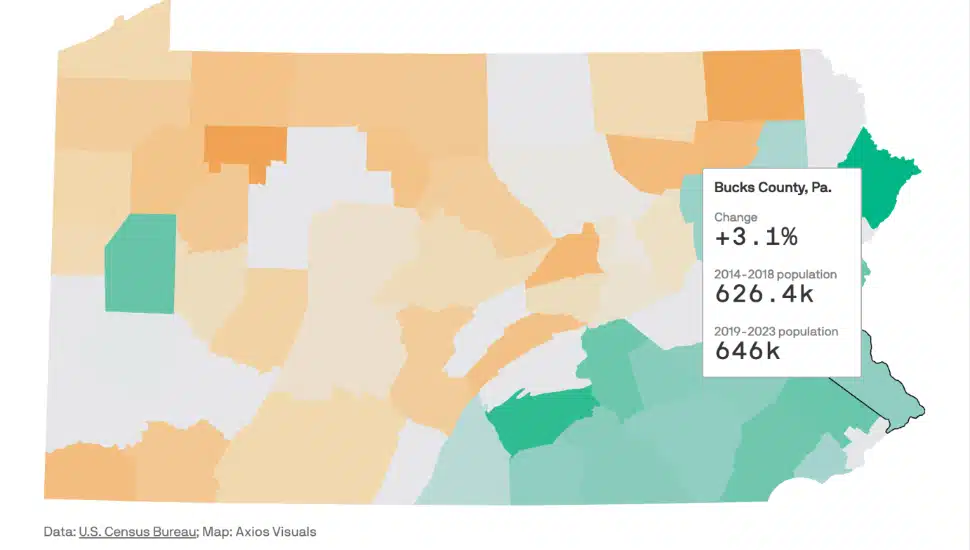
According to new U.S. Census Bureau population estimates released in 2025, Bucks County is growing, but not everywhere, and not evenly.
Some communities are steadily attracting new residents. Others are quietly losing them.
And the towns on each side of that divide are telling two very different stories about where Bucks County is headed.
.
U.S. Census Bureau · 2025 Population Estimates
Did Your Town Grow — or Shrink?
Some Bucks County communities are gaining residents. Others are quietly losing them. Explore the full interactive map from the U.S. Census Bureau and see exactly where your town stands since 2020.
Explore the Interactive Map →The data, which tracks population change from the 2020 Census base through July 1, 2025, shows a clear geographic pattern emerging across the county.
Central and Upper Bucks are gaining. Several established Lower Bucks communities are not.
Where people are moving
Chalfont Borough grew by 3.8% over the five-year period. Hilltown Township followed closely at 3.6%.
Lower Makefield Township added roughly 857 residents. Plumstead Township and Warrington Township each grew by about 2.4%.
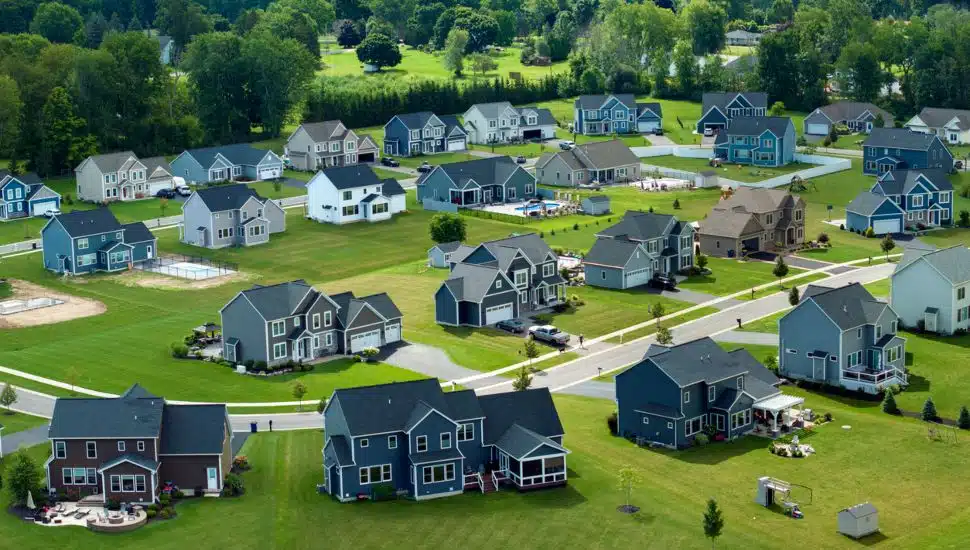
The towns posting the strongest numbers share a recognizable profile. Strong school districts. Newer housing stock. Open space, parks, and trails. Access to dining and shopping.
And something harder to quantify: a lifestyle identity that has become increasingly attractive to buyers and renters since the pandemic reshaped how people think about where they want to live.
These aren’t just suburbs anymore. They’re destinations people are actively choosing.
Where population is slipping
Not every part of Bucks County is on that upward curve.
Middletown Township lost an estimated 511 residents between 2020 and 2025. Falls Township declined by about 440 residents.
Warminster Township fell by roughly 344. Upper Southampton Township and New Britain Borough also posted smaller declines.
None of that automatically signals trouble. Many of these are older, established communities that are largely built out, with limited room for new housing development.
Population dips in these areas often reflect aging demographics, shrinking household sizes, and slower housing turnover rather than residents fleeing.
But the gap between the gaining towns and the declining ones is real, and it matters.
What the shift means
For decades, Bucks County was viewed primarily as a commuter county, a place people lived because it was close enough to Philadelphia and affordable enough to make sense.
That calculus is changing.
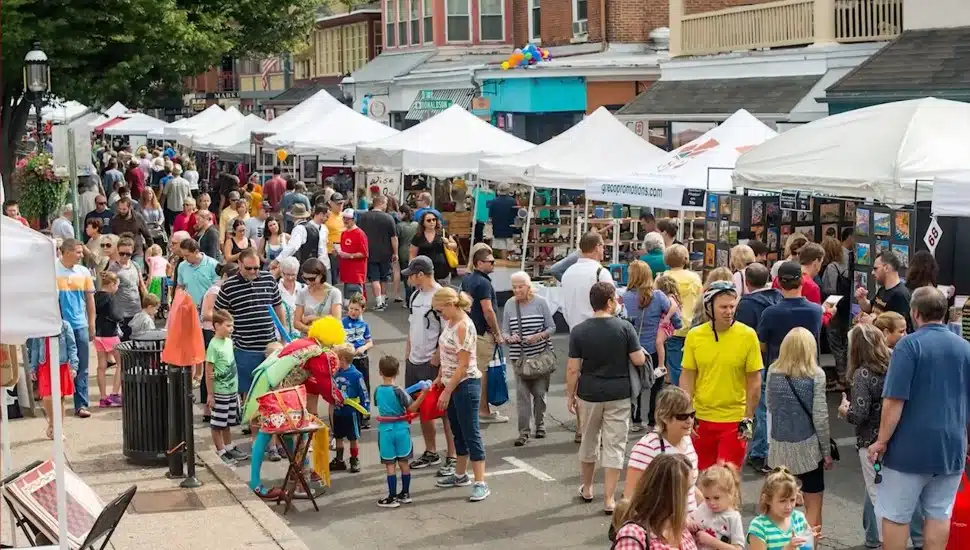
Increasingly, residents are choosing specific towns based on walkability, community character, recreation options, dining scenes, and overall quality of life.
The commute is no longer the whole equation.
That shift has consequences. Population growth drives school enrollment, housing demand, restaurant and retail development, and infrastructure investment.
The towns gaining residents today are likely to see more of all of that over the next decade.
The towns losing residents may find themselves making harder choices about services, budgets, and long-term planning.
Even relatively modest population movements can quietly reshape a county’s character over time.
In Bucks County, that reshaping is already underway, town by town, one household at a time.
Curious how your town stacks up? Explore the full interactive map from the U.S. Census Bureau’s 2025 population estimates and see exactly how your community grew or declined since 2020.
.
U.S. Census Bureau · 2025 Population Estimates
Did Your Town Grow — or Shrink?
Some Bucks County communities are gaining residents. Others are quietly losing them. Explore the full interactive map from the U.S. Census Bureau and see exactly where your town stands since 2020.
Explore the Interactive Map →_____