It’s not exactly the Hatfields and the McCoys, but the athletic rivalry between Kennett and Unionville is nonetheless intense, and it’s one that 37-year-old Kevin Hovde experienced from both sides.
The Kennett Square native spent his formative years as a student in the Kennett Consolidated School District, where he became enthralled with the community’s basketball culture.
“At that time, Kennett didn’t have football, so all the best athletes really gravitated toward basketball,” said Hovde. “It seemed like Kennett always won the Southern Chester County League, and when I was in middle school, the high school team went 26-0 (in the 1999-2000 season) and won the district championship before losing in the first round of the state playoffs. Two years later, they won the state title (in the 2001-2002 season). I grew up going to games, and like most young kids, I idolized the players on those teams.”
Just before the start of eighth grade, however, Hovde’s family moved to California.
“My father worked in the pharmaceutical industry, and he had to uproot the family to the Bay Area, where his company was headquartered,” Hovde said. “We were out there for about nine months, and it seemed like his job always had him traveling back east for business in the Philadelphia area. So, it became kind of silly for us to be living out there, and we decided to move back pretty quickly.”
In February 2002, the Hovdes returned to southern Chester County, having found a new home only a few miles away from their old one. But it was located in the Unionville-Chadds Ford School District, which meant the budding basketball star would graduate from Charles F. Patton Middle School, enroll at Unionville High School, Kennett’s neighboring rival, and compete against the players he grew up with.
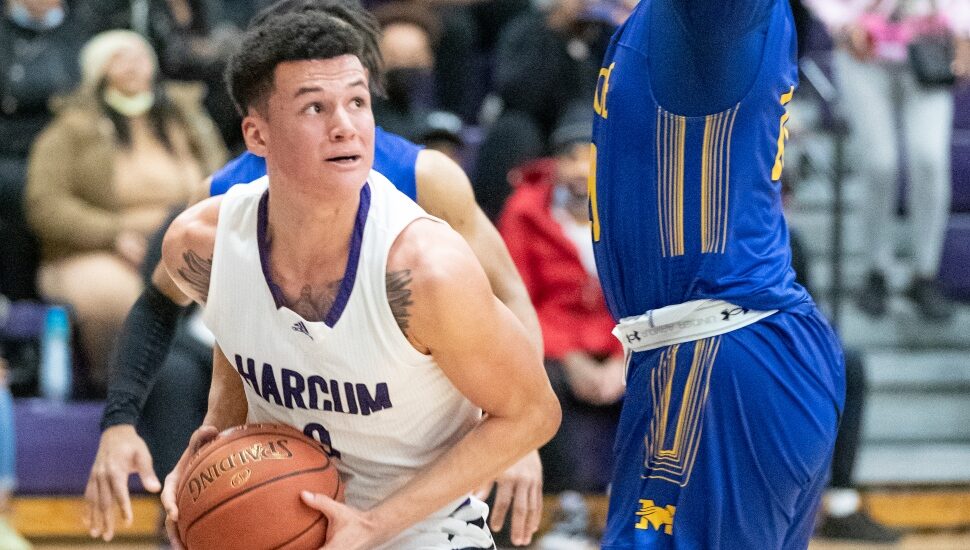
Entering Hovde’s junior season, Kennett had beaten Unionville the last 12 times they shared a basketball court, but the 6-foot-6 guard had blossomed into a Division I prospect and helped the Indians (as Unionville’s sports teams were nicknamed then) sweep the Blue Demons in the next four chapters of the Battle of Route 82. In the last one, Hovde scored 35 points in a 60-46 victory in front of a sold-out crowd on Unionville’s Senior Night.
He was named the 2005-06 Daily Local News Player of the Year for his exploits (21.5 points, six rebounds, seven assists, and three blocks per game) as a senior.
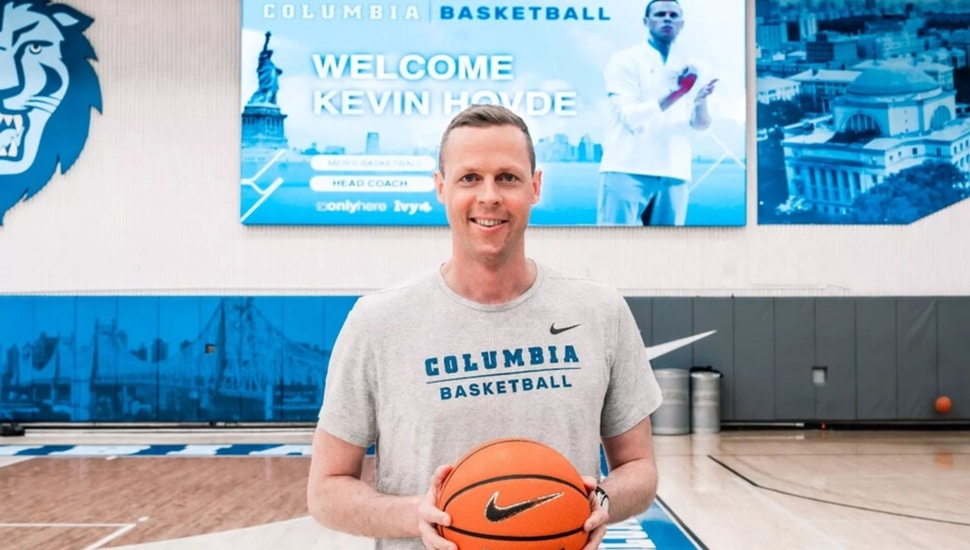
The memories remain vivid in Hovde’s mind but are filed away in its archives section, as the new head coach of the Columbia University men’s basketball team is busy preparing for his first season at the helm of a college program.
Last March, Hovde inherited the reins of Columbia after 13 years as an assistant coach on the Division I level, including the last three at the University of Florida, where he and the Gators won the national championship less than seven months ago. Being hired by Columbia was a full-circle moment for Hovde, as he spent his first four years in coaching as an assistant with the Lions.
Coaching was a career he knew he wanted to pursue after playing at the University of Richmond, where he walked on, earned a scholarship, and graduated with a degree in political science.
“When I committed to Richmond, the program was struggling, and I got to see it getting built (by new head coach Chris Mooney, a Philadelphia native and Archbishop Ryan High School graduate) from the ground-up,” said Hovde. “He did things the right way, with good continuity and a great culture. Seeing things come to fruition — where we went from a struggling program to one of the best in the country and making the Sweet 16 (in the 2010-2011 NCAA Tournament) — it was an experience that made me fall in love with coaching.”
The first stop on Hovde’s coaching journey is where he initially worked with Todd Golden, who was also an assistant at Columbia. The two later reunited as assistants at the University of San Francisco, where Golden was promoted to head coach in 2019. A successful three-year stint at USF enabled Golden to land the head job at Florida in 2022. He brought Hovde along with him, and in their third season, they won a national title.
Following the Gators’ 65-63 victory over Houston in the NCAA Tournament final, Golden signed a six-year, $40.5 million contract extension, making him one of the highest-paid college coaches in America. Hovde, meanwhile, was tabbed to return to Columbia, to resuscitate a program that finished last in the Ivy League with a 1-13 record (12-15 overall).
As he plans for a season that tips off on Friday, Nov. 7 at the University of New Haven, Hovde is focused more on process than results.
“It’s all about investing as much as you possibly can in the process and seeing what that can get you,” he said. “Working on defending, working on rebounding, working on taking care of the ball — those things will get us to where we’re hard to beat, right? I think that’s the main thing for a new program. You’ve got to make it where you’re not beating yourself and are doing the little things really well. We talk a lot about it with our guys, that’s it’s OK to get beat but not OK to beat ourselves. That’s what we’re trying to do right now: work on the little things that equate to winning.”
The majority of Columbia’s contributors from last season have returned, including five of the top six scorers. Given the current landscape of college sports, there are plenty of challenges Hovde will face in his attempt to rebuild the Lions.
The Ivy League, which does not offer athletic scholarships, has opted out of the settlement framework of the recent landmark antitrust lawsuit (House v. NCAA) that has reshaped college sports and allows schools to directly pay their athletes. The Ivy League does permit its student-athletes to engage in outside NIL (Name, Image, and Likeness) activities like endorsements and sponsorships, but they remain restricted from receiving direct institutional compensation tied to their athletic participation.
“You have to recruit guys who are insanely appreciative of the opportunity to play at Columbia,” said Hovde. “That’s always been a non-negotiable, but even more so now, with the way things are, with the way the rules are. You have to have guys who are going to appreciate the academic piece, the network that comes with graduating from a place like this.”
Nowadays, success in college basketball can be a double-edged sword for coaches. When one of their younger players performs exceptionally well, he suddenly becomes a prime candidate for recruitment through the transfer portal, with bigger programs offering more money for his services.
“We have to tap into the advantages we have compared to other schools,” said Hovde. “We want the players who won’t want to leave to make more money elsewhere because they’ll want to graduate from Columbia. It’s all about getting the right guys on the bus, holding them accountable at a high level, and giving them a great experience.”
For Hovde, the values driving his coaching career were shaped long before he ever wore a whistle. As he climbed the coaching ladder, he developed a philosophy centered on a commitment to hard work, steady progress, and the belief that culture wins over quick fixes.
Now, that philosophy takes center stage, just a fast break from Broadway, under the bright lights of the Big Apple.
______________
Mark Hostutler is the Senior Editorial Engineer at American Community Journals and the author of Heads of State: Pennsylvania’s Greatest High School Basketball Players of the Modern Era.