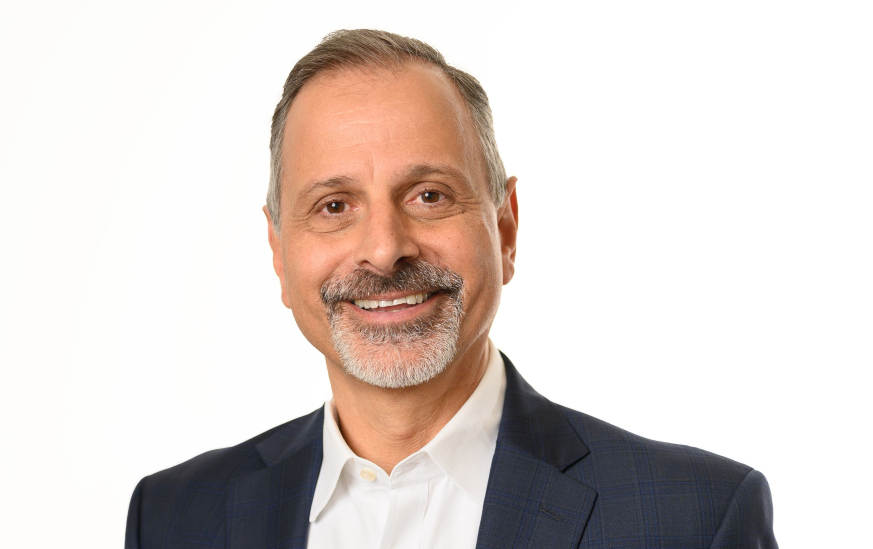
Joe Howard, Vice President for Enrollment at Widener University, grew up in the small town of Warren, Pa. He was a precocious and motivated kid who taught himself computer programming in second grade and, nudged by his high school English teacher, was the first person in his family to go to college.
Howard graduated from Mercyhurst University with a Sociology degree and a passion for education as a driver of social mobility and civic good. He discussed how Widener is adapting to changes in the higher education industry and how the university emphasizes its culture of belonging.
Where were you born and where did you grow up?
I was born the oldest of four kids in Warren, Pa., a small town on the edge of the Allegheny National Forest.
What did your parents do?
My father was a factory foreman, and my mom, when I was young, worked in a clerical role in a local mail-order catalog company. Later on, she was a service advisor at a series of automobile dealerships.
What do you remember about growing up in Warren?
It was a great place to grow up — the quintessential small town. Everyone left their doors unlocked, kids spent their days outdoors at the playgrounds or in the woods, and you came home when the streetlights were coming on.
I spent a lot of time at our local library. It was my refuge from a home environment that could be somewhat chaotic. I was also a precocious child — very curious, always wanted to learn, preferred spending time with adults — and a classic introvert. I loved getting to explore all sorts of things. I was fascinated with computers early on and with the help of books and access to computers in the library, taught myself how to write basic computer programs in the second grade.
I was also very interested in working as a kid; companies and businesses fascinated me. I knew that I wanted a job as soon as I could. In fact, as soon as I was old enough (12), I joined my grandfather as a candy striper in our local hospital, spending two days a week in summer and an evening per week during the school year, wheeling patients around or working in the hospital snack bar.
Where did that work ethic come from, Joe?
I was always motivated, and I had a lot of adults in my life who encouraged that, like my grandparents, my mom and dad, and teachers. I was blessed with having people who saw something in me that I wasn’t yet aware of. For instance, in second grade, I had a teacher who let me take the lead on running the multiplication lessons.
What do you think they saw in you?
Probably a kid who was smart, ambitious, and a little reserved, so it took other people to pull me out. I wasn’t necessarily college-bound. When I turned 15 and I could get my working papers, I went to work at a miniature golf course and then worked at the Dairy Queen. I became the Sunday Manager at the Dairy Queen as a high school junior. I honestly thought that I would go on to own or manage a restaurant or a hotel.
In 11th grade, I had a demanding, but well-intentioned English teacher. She was the type of teacher who made students show their report cards and PSAT scores when they were released. She pulled me aside one day and was like, “You need to go to college.”
Did you play any sports in high school?
I swam on the varsity team all four years. I was also our Class Treasurer in student government, did all the class plays, and did a stint on the prom committee … those sorts of things. I kept myself ruthlessly busy.
What kind of music did you listen to growing up?
I was all over the place, but I joke that my teenage angst phase was definitely Third Eye Blind. I still love their music to this day.
Did you go to any concerts when you were a kid?
No. While there are many great things about Warren, I grew up in a very low-income family, facing the challenges that came with it, including multiple household transitions. As a result, I lived a very sheltered life. One of our biggest outings was our annual trip to Erie for the amusement park.
So, why Mercyhurst, and was it a good choice for you?
Again, my English teacher. She knew my interest in possibly managing a restaurant or hotel and Mercyhurst had a large hotel/restaurant management program. She also said, “Mercyhurst is the type of school that will prop you up with every stick it has.” She encouraged me to apply and, thankfully, I got in. And, because of my financial circumstances and my academics, got a very generous scholarship. It was the only college I applied to.
As it can be for many students, the transition to college was hard for me; I went from being a big fish in a small pond to a much larger environment. I developed pretty severe social anxiety. It was a lot. I was the first person in my family to go to college. It wasn’t until college that I really realized I came from a poor family. I struggled with a lot of the things that new students tend to struggle with.
It took a lot of people to prop me up. My academic advisor and work-study supervisor kind of mothered me during that first year. The director of my hotel/restaurant program was a force of nature, and the counseling and health centers helped me navigate my anxiety issues. Between those support systems, I settled in, found a good group of friends, and, by the second and third trimesters really started thriving.
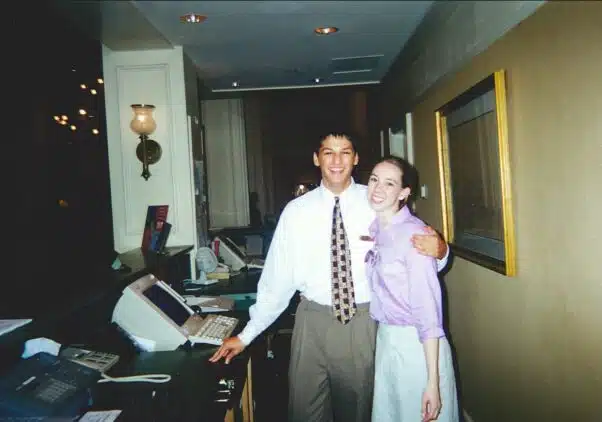
I didn’t graduate as a Hotel/Restaurant Management major. One of the graduates of the program ran the Westin resort in Hilton Head Island and would bring down about 30 students from Mercyhurst to do summer gigs. I got selected as a freshman to participate. I was placed at the front desk of this resort. I loved it and learned all sorts of things. But I wasn’t sure that long-term, it was the trajectory for me.
In my sophomore year, the vice president for academic affairs was relaunching the Mercyhurst-in-Ireland program. I, somehow, was selected to participate in that and spent a semester studying in Belfast, Ireland. During that semester, I got to backpack through Europe with one of my best friends for three weeks.
The combination of those experiences really broadened my worldview. I became interested in homelessness, the social conditions of people, and socioeconomic issues. I came back to Mercyhurst and sat down with my academic adviser in Hotel/Restaurant Management and said, “I think I want to switch to Sociology.”
While I was at Mercyhurst, I was a Campus Tour Guide, I was a Resident Assistant, I worked in the office of residence life, and by my senior year, I was a part-time employee in residence life. I was the Design Editor for an alternative publication that the student government put out. My summers were spent living on campus and working for residence life. I found my home.
Mercyhurst was a big transition for you. You had a completely different worldview by the time you graduated.
Yeah. That caused some tension with my family. I remember getting made fun of one Christmas for using a word that was just a little too big. But, you know, college can functionally transform people’s lives, and I experienced that.
Who else saw promise in you, opened up doors, and gave you opportunities?
Laura Zirkle was the Dean of Residence Life and Student Conduct at Mercyhurst. When I graduated, she hired me as a Graduate Assistant Hall Director and, eventually, as an Assistant Director. She served as my mentor for my entire life; frankly, I consider her family at this point.
I learned a lot of leadership lessons from her. Student conduct work drives a lot of critical thinking skills. Residence life can teach you everything you need to know to be a good professional. You’re doing everything from community building to confronting peers to managing a modest budget.
The other person is Jeanette Britt. In 2008, Jeanette had just been named the Assistant Vice President for Advancement, and she and a new vice president were looking for someone to be the director of alumni relations and annual giving. I went over and had a conversation with them, and they picked me over a candidate with decades of experience.
Jeanette mentored a different side of my leadership and approach. She’s a computer programmer by training and has her MBA. With Jeanette, I got more of the tactical side. It was the first time I wrote an annual plan or developed KPI reports to monitor progress.
Jeanette later became the Vice President for Information Technology at Mercyhurst. Laura was later named Vice President for Student Life. So all three of us were together as vice presidents at Mercyhurst for six years. It was kind of surreal to go from having supervisor-supervisee or mentor-mentee relationships to essentially being peers.
Why do you think they selected you for the role in advancement over that more experienced candidate?
You’ve got to have fire in the belly, and I did. I walked into that first conversation with ideas and observations. And I worked hard. It’s only in the last five to seven years of my life that I would not classify myself as a workaholic. And I think they also saw that I am not slow to act. When I see something that needs doing, I want to see it done and I’m glad to help get it done. I also believe work worth doing is worth doing well, and I take deep pride in my work.
The speed of change is absolutely essential in today’s environment. The pace of our industry, the competition we’re facing, the regulatory environment — all of those things don’t always allow us the benefit of making all of our decisions over a long period. Higher ed is an industry in contraction. There are fewer students graduating high school, which means there are fewer people going to college. Pennsylvania is one of the nation’s most saturated markets. We have the same number of colleges as Texas, and yet we have about 60 percent fewer young people. And the college-going rate is going down, so even among the young people we do have, fewer of them are going to college.
How would you like Widener University to be perceived amongst the students you’re trying to recruit and their parents?
Fundamentally, we are about educating learners who will help “create better futures.” We promote social mobility and the civic good. We want our students to go out and obtain excellent careers (and they do!), but we also want our students to be good citizens of the world. Our community helps our students do that.
We take the social mobility part of our enterprise quite seriously, too. A good share of our students — undergraduate, graduate, and law students — are the first in their families to go to college. At our best, higher ed fundamentally transforms lives.
Our President, Stacey Robertson, when she got here, helped our community orient around three priorities: enrollment, student success, and belonging. We are a community, and we take the meaning of community seriously. We surround our students with a team of folks to help them thrive in college. We want every one of our students, faculty, and staff to personally feel seen and individually valued.
Here we are in the first quarter of 2025. What are the challenges, opportunities, and priorities that you’re focused on?
The challenges are always enrollment. It means that we have to adapt to today’s college students. Today’s college-goer is different than someone going to college 10 and 20 years ago. They’ve faced more difficult life circumstances — the pandemic’s effect on learning loss, the overall isolation, and the anxiety that caused in students.
Recognizing that students come with different challenges, we can brace against that, or we can acknowledge that’s the reality and adapt to meet students where they are. We’ve done a lot of work around that on the admissions and onboarding side.
Going to college involves a whole new set of bureaucracies, vocabularies, and systems. Many students don’t come prepared to navigate those systems, and that can be true whether you’re an 18-year-old undergrad student or a 35-year-old graduate student. We’ve spent a lot of time and energy trying to figure out how we do that onboarding and transition experience in thoughtful, strategic, and supportive ways.
We’re also looking at the student success side now. Once the students are on our campus, what barriers or roadblocks might we be unintentionally putting in front of students on our campuses, in their classroom environments, or in our financial aid process? To help us, we’re partnering with an agency, the National Institute for Student Success, to do a 360-degree analysis of our campus. We’re asking ourselves: How we might change in the interest of helping more of our students succeed?
What do you do with all that free time that you have?
I enjoy traveling with family and friends. I’m big into concerts and shows. And I consume a ton of podcast content.
My contemplative spot here is the Philadelphia Art Museum. I am easily there two to three times a month. It’s a place that I’ll go, meander, think. It’s my anchor in the city.
Three last questions for you, Joe. What’s something big that you’ve changed your mind about over the last 10 years?
Honestly, I don’t think my core principles have shifted. I can see, in a paper I wrote during my junior year of college, how I was thinking about education as a driver of social good.
One of the things I’ve thought about a lot lately as it relates to higher ed is that colleges and universities don’t stand up for themselves very well. Higher education has taken a bruising in media and political circles for the past decade and we don’t push back on it. In part, we think it would be a little unseemly. And there’s such heterogeneity in the types of institutions that our interests aren’t always aligned.
But I worry about the degree to which national messages are convincing people that college is the wrong call. Most people think college is more expensive today than it was 20 years ago, when, in fact, in inflation-adjusted terms and looking at students’ actual out-of-pocket costs, the costs have actually been going down. Fewer students are graduating with debt than they were 20 years ago. But these aren’t what we hear in popular narratives. I worry about 17-year-old Joe Howard hearing all of these messages telling me that I shouldn’t even think about college. I think we do qualified and motivated young people a disservice when suggesting that a college degree is a bad investment.
What keeps you hopeful and optimistic, Joe? It’s a crazy world out there.
Young people. As a College Administrator, I have the honor of watching young people come in as anxious new students and graduate as different people who go on and do amazing things. Today’s young people have a lot of challenges, but I think students today are far more kind, inclusive, and vulnerable than people in my generation. I think we’re far too cynical about young people.
I agree. Finally, Joe, what’s the best advice you’ve ever received?
I’ll go back to my grandfather. He was a man of modest means. Like my dad, he worked in a factory his entire life. But he took character and honesty seriously, and so do I.
Integrity, character, and honesty are the core virtues that he instilled in me, and I like to think I demonstrate those values to this day.